Why Write About Fragments?
Because they leave us with more questions than answers. For historians, and any inquisitive mind, it is into that great unknown that we dare to tread.
Rather than giving the whole picture, fragments place the onus of discovery on us.
While it is a common assumption that fragments are the domain of archaeologists and their amazing material finds, they abound in the literary world, too. There are many examples of unfinished poems and stories, and antiquity yields many broken-off gems from speeches, letters, orations, and treatises – remnants of larger, lost works.
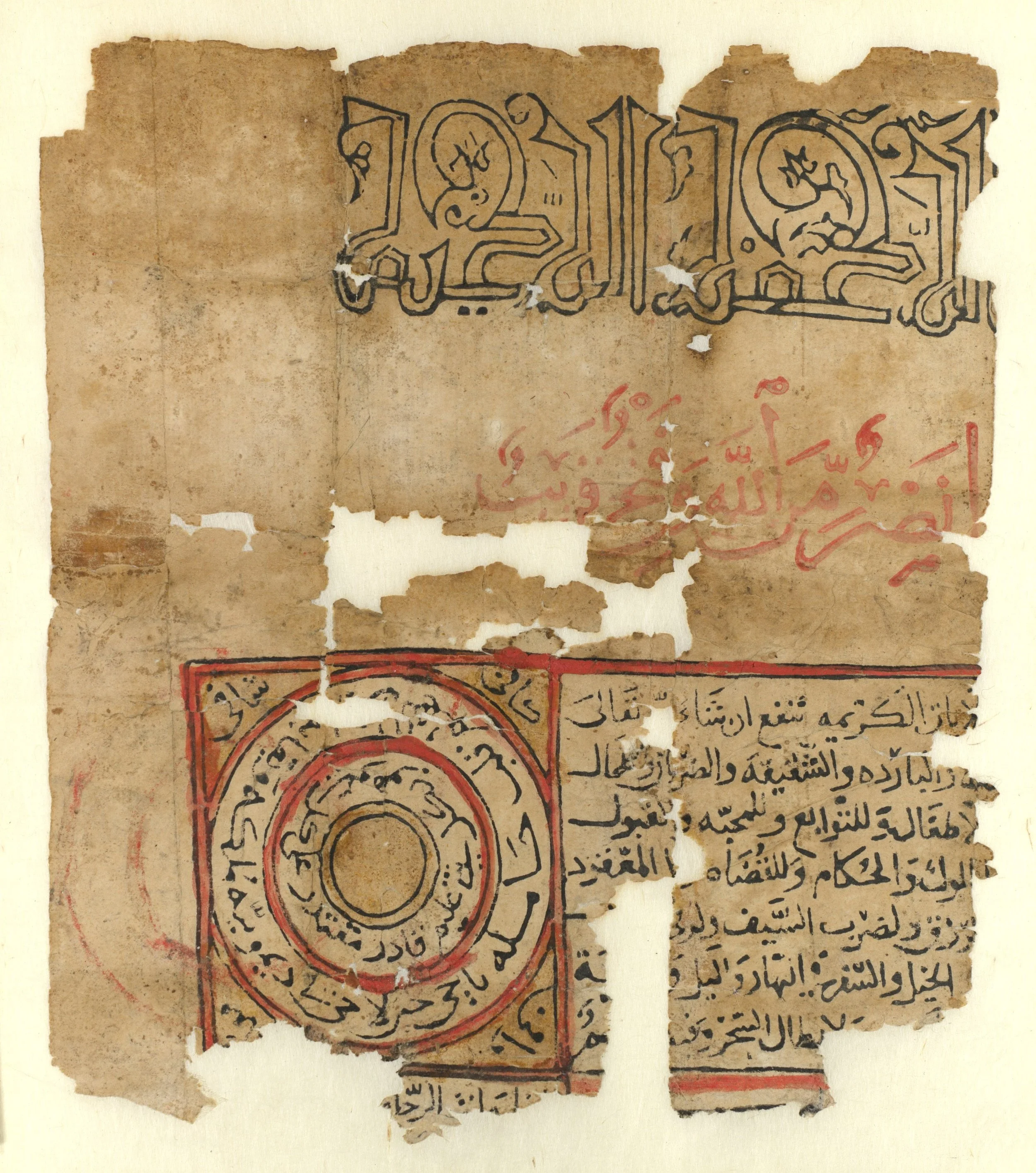
Fragment from a Talismanic Scroll. 11th–12th century.
Only the upper left corner of this page has survived. The text, which includes a passage reading "the heart of the one who wears it," together with the evidence of folds on the paper point to its original use as a talisman to be carried in an amulet box that was worn as a pendant. Courtesy of the MET.
Annotations can be fragmentary, too. I find scribbled notes in the margins of old books most intriguing, as they invite the reader to wonder: What was this person thinking when they wrote that? Where were they sitting at that moment? What was happening in the world at that time?
Many ancient historians have left us extant texts, though rarely complete ones. Cicero, for example, gifted us a treasure trove revealing the social and political life in Ancient Rome, while others left us the bare minimum. Fortunately, fragments of one author’s lost work often survive through the writings of others who had access to the originals and quoted or referenced them.
The important thing is to be diligent in cross checking with all available sources to preserve accuracy and context. Too often, we tend to interpret ancient activities through a modern lens. The lesson is to learn from the past, not to reshape it to suit our own ends.
If antiquity gave us fragments by accident, the modern world does so through intention. Social media is perhaps the closest thing we have to classical fragments – we’ve been conditioned to write in short, snappy bursts. The Instagram carousel takes this further still, positioning brief sentences across a corresponding image. The art of journaling and collaging would perhaps be the most fragmentary practices of all and enjoying quite the renaissance among young women. I applaud it, from the soothing effects on the mind, and how it can link what we do in one moment with something from the past, or to some inkling of the future.
I have created a new section on my website called Fragments Of Time. It is dedicated to showcasing fragments of historical, literary, mythological, and civic discourse, compiled in various forms for readers to absorb at leisure. It is a work in progress, and I will add more over the coming months.
I sincerely hope you enjoy digging around in the fragmentary archives. And please leave your comments and let me know your thoughts 🏛️