Who Would Not Admire Man?
I have lately laboured over this question asked by the Renaissance philosopher, Pico della Mirandola:
Are there any who would not admire man?
For weeks I have put off writing about it, even though I had a seed of the idea. It seems the right time to address it now, not to point at any single event or individual, but because the last few years have left many of us reassessing how much trust we place in our institutions, our leaders, and even in each other.
Let’s face it, life just hasn’t been the same since 2020.
So, why would we wonder at man? Is it a question many of us have even asked ourselves? Is it a worthy one? And what would be our answer?
Pico clearly considered it worthy as he wrote an impassioned oration entitled, The Dignity of Man, in which he elevated mankind’s worth so highly that our rank deserved to be envied by the stars and minds beyond this world.
That is a big call for a species who has the ability and the willingness to inflict heinous acts of brutality against their fellow humans and other creatures. And while we’ve been doing so for thousands of years, it gives it another meaning when we bear witness to evil in our own times.
“At last it seems to me I have come to understand why man is the most fortunate of creatures and consequently worthy of all admiration and what precisely is that rank which is his lot in the universal chain of Being—a rank to be envied not only by brutes but even by the stars and by minds beyond this world. It is a matter past faith and a wondrous one. Why should it not be? For it is on this very account that man is rightly called and judged a great miracle and a wonderful creature indeed.”
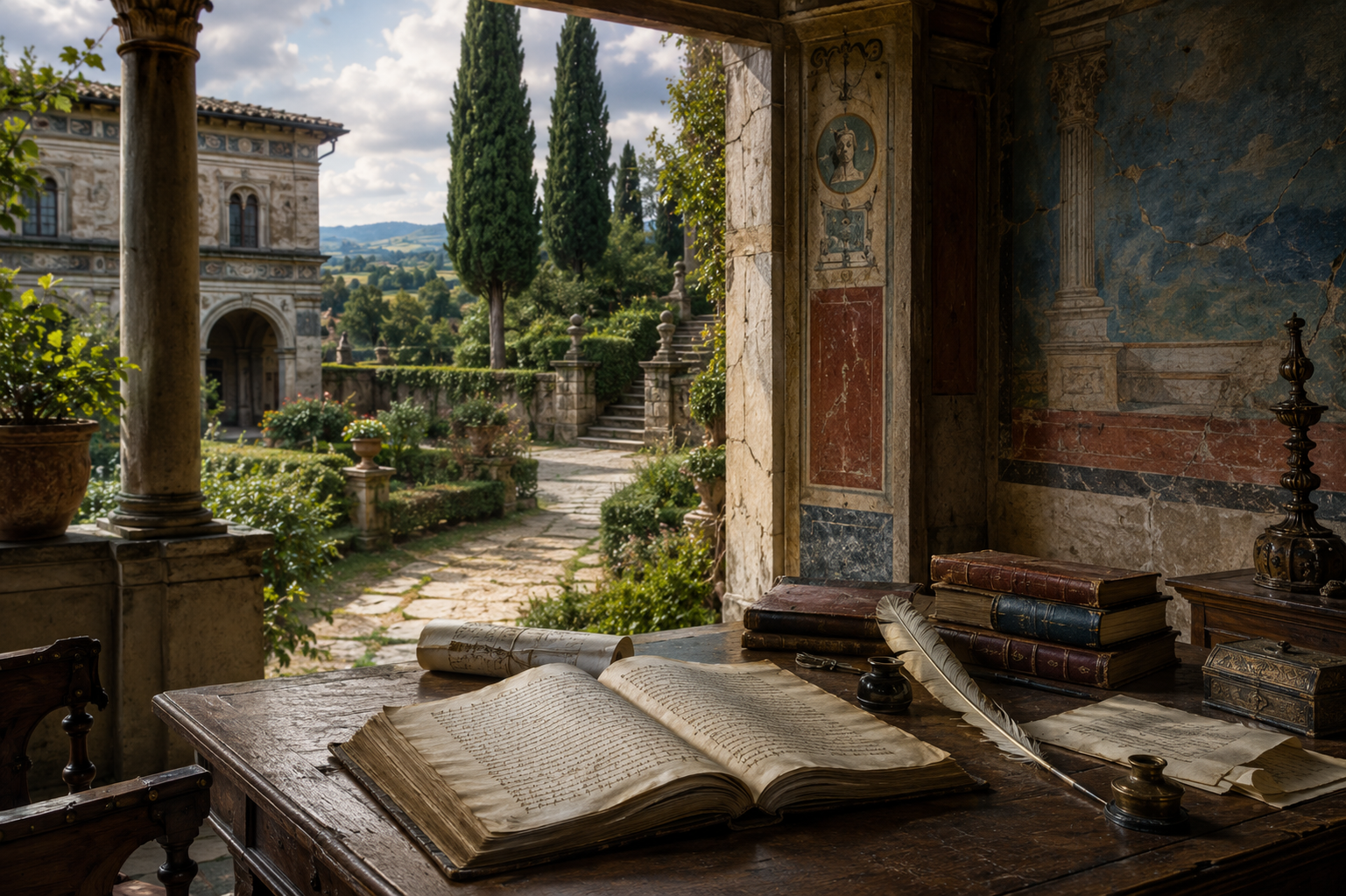
The intellectual space of seeing mankind in different ways. Author’s own AI image.
Pico argues that man has been gifted a freedom like no other creature, to be able to transform his life from all manner of natures into other sorts: happy to sad, kind to brutish, rational to irrational. He paints a picture of a work in progress. And this freedom to continually transform is the true source of human dignity. He celebrates our pure unending potential to climb every rung of the ladder of possibilities.
Leap ahead one hundred years, and we read that Michel de Montaigne has a different assessment; a rather more contrite one. He writes that we are a deeply flawed species, being full of imperfection and not easily attuned to choosing virtue over vice.
“Our being is cemented together by qualities which are diseased. Ambition, jealousy, envy, vengeance, superstition and despair lodge in us with such a natural right of possession that we recognise the likeness of them even in animals too – not excluding so unnatural a vice as cruelty; for in the midst of compassion we feel deep down some bittersweet pricking of malicious pleasure at seeing others suffer.”
To contrast his view with that of Pico’s glowing appraisal and unlimited chances to renew ourselves with ease, Montaigne gives us an example that counters such a utopian view. He cites the Roman emperor, Tiberius, who we are told from ancient authors was a deeply flawed and cruel man – a view that has been challenged in modern times. But let’s stay on the Renaissance timeline for now.
One of ancient Rome’s most dangerous enemies, Arminius, was standing in the way of Tiberius’ plans of expansion. A German chief offered to poison Arminius, one that was refused by the emperor. Montaigne describes the following response by Tiberius:
“The Roman people were in the habit of avenging themselves on their enemies sword in hand, by overt means not by trickery and covert ones.”
This act is framed as one of choosing honour over usefulness, noting that someone as morally compromised as Tiberius pushing back on such betrayal, presents the human character as one where honour does not come easily, and requires much effort to choose it. In effect, moral consistency is the exception rather than the rule – a view in contrast to Pico’s celebration of man’s unending thirst for improvement and acquisition of dignity.
While both writers acknowledge human imperfections, they diverge on our natural tendency toward virtue.
To return to why this topic caught my attention: it is the melancholy of our modern times and the relentless pursuit in trying to understand ourselves given that we seem to never learn the lessons of the past. Now, most generations could argue the same, as few of us are satisfied with the times we are born into – a topic which I addressed some months back if you feel inclined to read here.
Perhaps that is why Pico and Montaigne still feel so close at hand. Every generation at some point reevaluates its trust in leaders, institutions, and in each other. And every generation rediscovers, often the hard way, that virtue and vice exist uncomfortably in those institutions as well as within each of us. As someone who constantly asks probing questions, this wasn't specifically one I had asked myself. But I do believe it is a worthy one, because if we were to each extract our own understanding of such a broad but meaningful question, we may be on our way to trying to improve our own generational lots.