From Tea Shop to Ancient Courts: A Mouldering Pleasure
On Emily Dickinson, Machiavelli, and the Mouldering Pleasure of Antique Books
I have lately been rather captured by visiting classical literature of the nineteenth century. This detour from writing about my beloved ancient Rome and all manner of things antique, led me to an unexpected discovery in a tea shop.
When you chance upon the unexpected, is it providence, or only the quiet mischief of chance?
Happenstance ~ Serendipity ~ Fortuitous ~ Unforeseen ~ A happy coincidence.

When a chance encounter on a mission to buy tea, leads you to a nineteenth century famous American writer.
On a perfectly ordinary visit to a tea shop, I found myself drawn to a small blue box. Inside was a packet of a new blend, and beneath it, tucked away like a secret, a little black book by the nineteenth century author, Emily Dickinson.
I confess that I have not read much by Emily, perhaps a few poems here and there when I was younger. Upon arriving home and opening up this little black book, my interest was piqued to know more about one of America’s greatest writers. The small blue box that housed the book certainly added to the intrigue – clearly so, for I would not have picked it up and surveyed the mystery of it in the first place.
First of all, I have to say that the tea blend was superb! It was inspired by Emily’s coconut cake recipe, with notes of sweet coconut gracing the palate just perfectly.
Now, on to the book, whose title was as far away from coconut cake as one could get – My Life Had Stood a Loaded Gun. I was told by the lovely lady in the tea shop, who herself had read a lot of Emily’s work, that it is quite dark and dismal – perhaps one could say almost “loaded,” as when I turned each page, the title befitted every poem therein.
One poem in particular took my fancy as it was based upon antique books – my great love. In this, I saw a link to Niccolò Machiavelli, who wrote of his great desire each night, when his work was done, to disrobe and change into more suitable attire in order to read the works of ancient men.
I see old books as living interlocutors, not just as they are able to speak to us in the twenty-first century, but how they connect with one another across history’s timeline.
An important note: As copyright prevents me from quoting from this miniature Penguin edition, the following references of Dickinson are drawn from those accessed via the public domain.
So, let us take a trip back to 1863, before going further beyond in time to 1513.
‘A precious, mouldering pleasure ’tis
To meet an Antique Book,
In just the dress his century wore –A privilege, I think…’
Dickinson knew the deep resonance of finding one’s true companion on a shelf, perhaps bound in a crumbling cloth with pages of worn, faded edges. Those old volumes, those antique works, represent a meeting of minds.
Three centuries before, Niccolò Machiavelli described a similar nightly ritual:
‘On the coming of evening, I return to my house and enter my study; and at the door I take off the day's clothing, covered with mud and dust, and put on garments regal and courtly; and reclothed appropriately, I enter the ancient courts of ancient men, where, received by them with affection, I feed on that food which only is mine and which I was born for, where I am not ashamed to speak with them and to ask them the reason for their actions; and they in their kindness answer me; and for four hours of time I do not feel boredom, I forget every trouble, I do not dread poverty, I am not frightened by death; entirely I give myself over to them.’
In his study, Cicero and Livy were as present to him as any living patron.
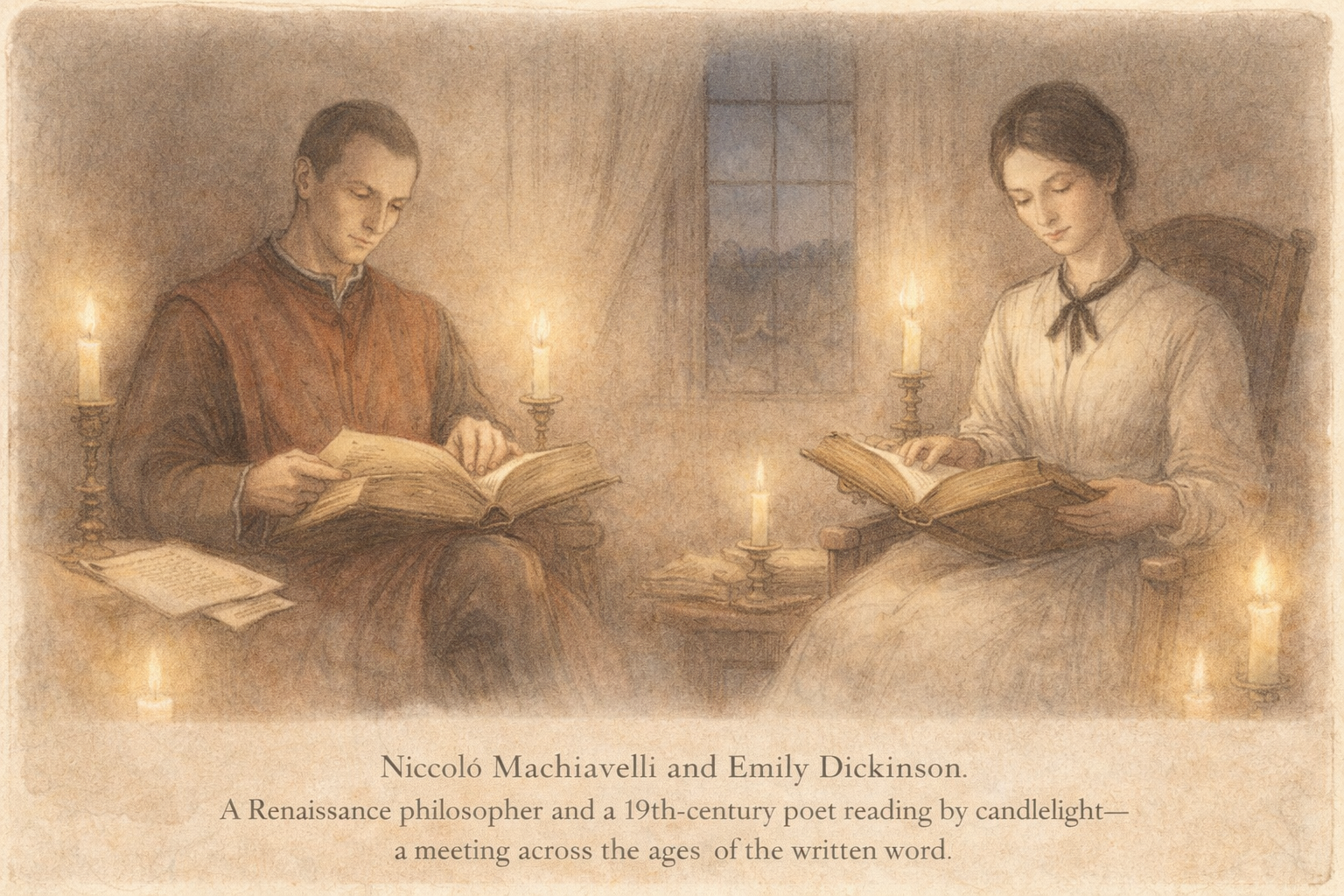
A meeting of minds from the Renaissance and the Early Modern Era. AI assisted image.
Machiavelli and Dickinson were bound together at night, locked into a point on the timeline, accessed through a portal of antique inquiry and wonder.
As an historian of ancient Rome, I recognise their ritual. The mouldering pleasure and the evening audience are my own: to sit with texts whose pages are older than my country, and to ask these long‑dead Romans why they chose as they did.
Dickinson gives language to the quiet ecstasy of opening the book and recognising the mutuality of minds.
Machiavelli gives language to the courtly seriousness we feel when we take our place among the great court of nobles and men of letters.
I see their engagement as a place to go when our contemporary world becomes overwhelming; where an escape is sought for serenity and contemplation.
It is a place to live where dreams were sown, if only for a while.