The Time in Which We Were Born: Poets, Power, and the Principle of Right
Who among us can say that we are genuinely satisfied with the time in which we were born?
It is a question that can elicit an immediate “yes” or “no” response, until further reflection gives us pause. Some people are more accepting of fate than others; it is a surety, after all, that we have no say in the matter. Yet many of us wonder what adventures we might have lived had we been born in another time and place.
This question caught my attention upon reading a statement by the Scottish classicist, Lewis Campbell, in the introduction to his translation of Aeschylus’ Seven Plays:
‘Twice within human memory have great poets been heartily satisfied with the time in which they lived.’
Campbell is speaking of poets, whereas I pose this question more broadly, to all people. Still, it is a worthy one in the larger scheme of how we live our lives in a world that is changing at such a rapid pace.
Given Campbell’s insight into the past, his claim that only two poets throughout history up until his time of writing in 1902 were “heartily satisfied” casts a blazing light upon the stability and security of our world – namely, the lack of times sound enough for creative minds to declare them of the highest order.
He identifies two periods in which, as he puts it, the ideal and the actual are interfused:
1. Aeschylus, Greek poet and soldier, writing during the height of Athenian power.
2. Spenser and Shakespeare, writing in the fertile climate of the Elizabethan age.
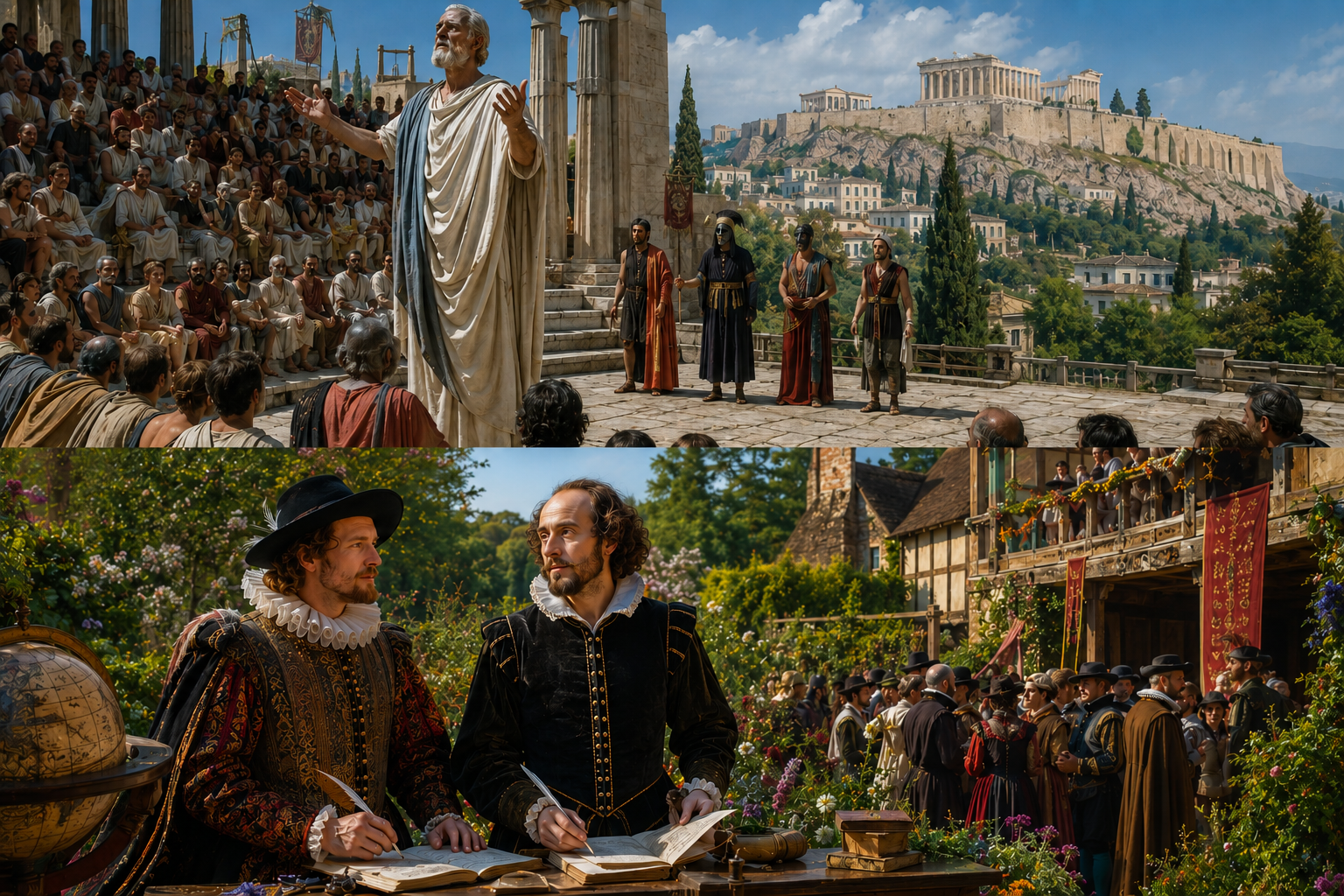
The two times in history where poets considered themselves “heartily satisfied,” according to the Scottish classicist, Lewis Campbell - Aeschylus during the height of Athenian power; Spenser and Shakespeare during the Elizabethan era. Author’s own AI generated image.
Campbell argues that the secret lay in the principle of Right, which he regarded as “the cornerstone of civilisation, and [which] alone makes national life worth living.” For these three poets, it seemed possible to imagine that the glory of Athens and the reign of Elizabeth would spread and continue.
Has that hope been fulfilled in the five centuries since, in our own time? Or are we facing a backward slide toward the conditions Aeschylus showed his Athenian audience 2,500 years ago?
Campbell describes how Aeschylus showed his audience the contrast of times in the hope they would reflect on their present good fortune. To emphasise the fame of Athens, he presented plays that recalled the poverty and insecurity that remained after the Greek victories over other peoples: examples of how protection was still a matter for debate; the marriage law was still not fixed; liberty was not yet born; nor the reign of law inaugurated.
He writes that there was one thought, one image, and one dominant idea built within the plays of Aeschylus:
‘…the idea of righteousness, as the goal towards which all human actions are inevitably drawn or driven: the resultant of all forces, whether consentaneous or opposed; the reward, the punisher, the final reconciler.’
If only two poets considered their times to be the most fortuitous in all of history down to 1902, where does 2026 fit into the equation of “living in the best of times?”
We have achieved the things Campbell held up for the ancient Greeks to ponder – rule of law, marriage rights, protection rights, liberty. But are we satisfied?
Lives of immediacy, convenience, and a false sense of freedom cloak something much darker – the risk of enslavement via technology and data harvesting, leading to a world of total surveillance by powers that seek only to control our every move.
I doubt that Aeschylus, Spenser, or Shakespeare – all of whom produced drama, tragedy, and comedies that mocked the shortcomings of authoritarian rulers – would consider such an existence a triumph.
It begs the question: who would?