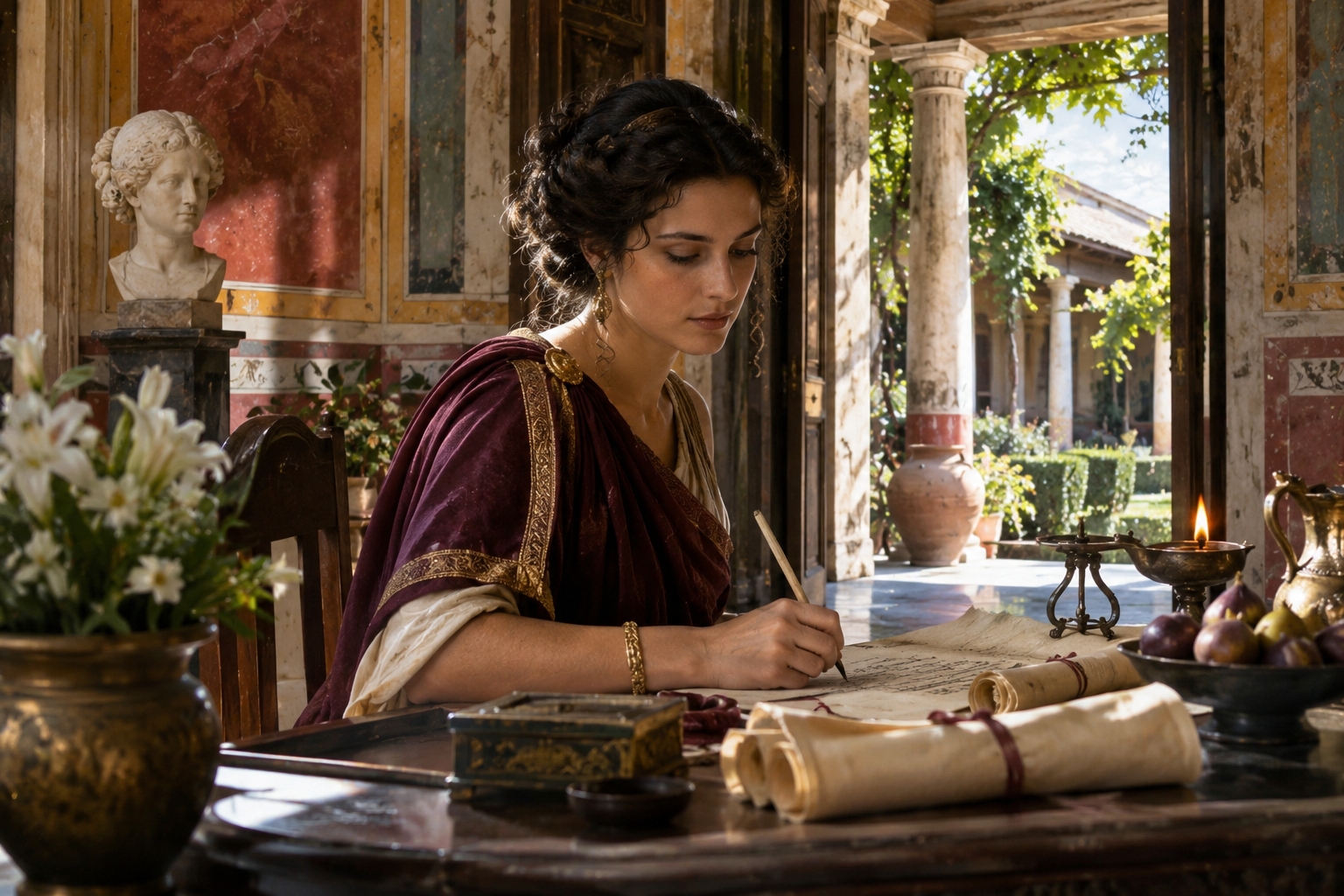
‘The letter, like the dialogue, should abound in glimpses of character. It may be said that everybody reveals his own soul in his letters. In every other form of composition it is possible to discern the writer's character, but in none so clearly as in the epistolary.’
~ Demetrius
Tullia
Letters to Friends
PREFACE - proemium
‘That there are many different categories of letters you are aware. But the most authentic, the purpose in fact for which letter-writing was invented, is to inform the absent of what it is desirable for them to know, whether in our interest or their own.’ (Cicero, 53 BC)
The ancient Romans revelled in writing letters. It was a serious pursuit, and sometimes more than one would be written and dispatched on the same day.
We have approximately 900 letters written by Cicero to various friends, family, and political colleagues. They reveal the inner workings of life in the late Roman Republic, both the brutal, the less brutal, and a sprinkling of the more subdued. As a leading man in the Republic, he saw it as a duty to keep up with correspondence as being an integral part of how the entire Roman world operated – communication was the key to every event, either unfolding or having already occurred.
He had two children – a daughter, Tullia, and son, Marcus. Tullia was the light of his life. When she died in 45 BC at the age of 31, he was devastated. He wrote to a friend of losing the one person who he could turn to when the brutality of political life became too much to bear:
‘I had a haven of refuge and repose, one in who conversation and sweet ways I put aside all cares and sorrows.’
We know from Cicero’s letters that he valued Tullia’s input on political matters, but of the young woman herself, we know little, other than a few references by Cicero scattered throughout his correspondence.
I am embarking on an imaginary journey into Tullia’s world, presented through a series of letters written to her freedwoman and friend, Sophrona.
The letters are a work of fiction, as is her friend, but they are set against the backdrop of the period in which she lived – the late Roman Republic, in the decade before Julius Caesar was assassinated in 44 BC.
There are references to historical events, occasions, culture, or individuals in order to serve as the legitimate backdrop to this pivotal and exhilarating period in time. In some cases, creative licence is used, primarily due to our lack of knowledge in some areas where I feel it is useful in advancing the story – as an example, the name and location of certain villas and their owners. Names of fictional characters are based upon typical Roman or Greek names of the day.
Below you will find each letter published in order of writing.
Entries will be added regularly so you, dear Reader, can follow Tullia’s journey.
I welcome you to the imagined world of Tullia, daughter of Rome, and affectionately known by her father, Cicero, as “Tulliola.”