Writing and Reminiscence
To Write or Not to Write?
A Reflection on Plato’s Phaedrus.
The famous old god, Theuth, presented to the god and king of Egypt, Thamus, a new invention – letters.
Theuth claimed they would make the Egyptians wiser and improve their memory. But Thamus rebukes the old god’s claim, saying that letters were an aid only to reminiscence, not to true memory.
He argues it would make people forget because they would come to rely on external written characters rather than exercising their own memory and judgment. It would ultimately result in a mere semblance of truth rather than truth itself. Truth, by contrast, is refined in the testing of a living exchange – dialectic. Plato has Socrates describe writing as a “garden of letters” – a place to sow and plant for the sake of recreation and amusement.
This dialogue between Socrates and Phaedrus took place around 370 BC, yet it speaks to our own age in a way that is even more confronting than what the ancient world faced. I refer to social media and the use of AI.
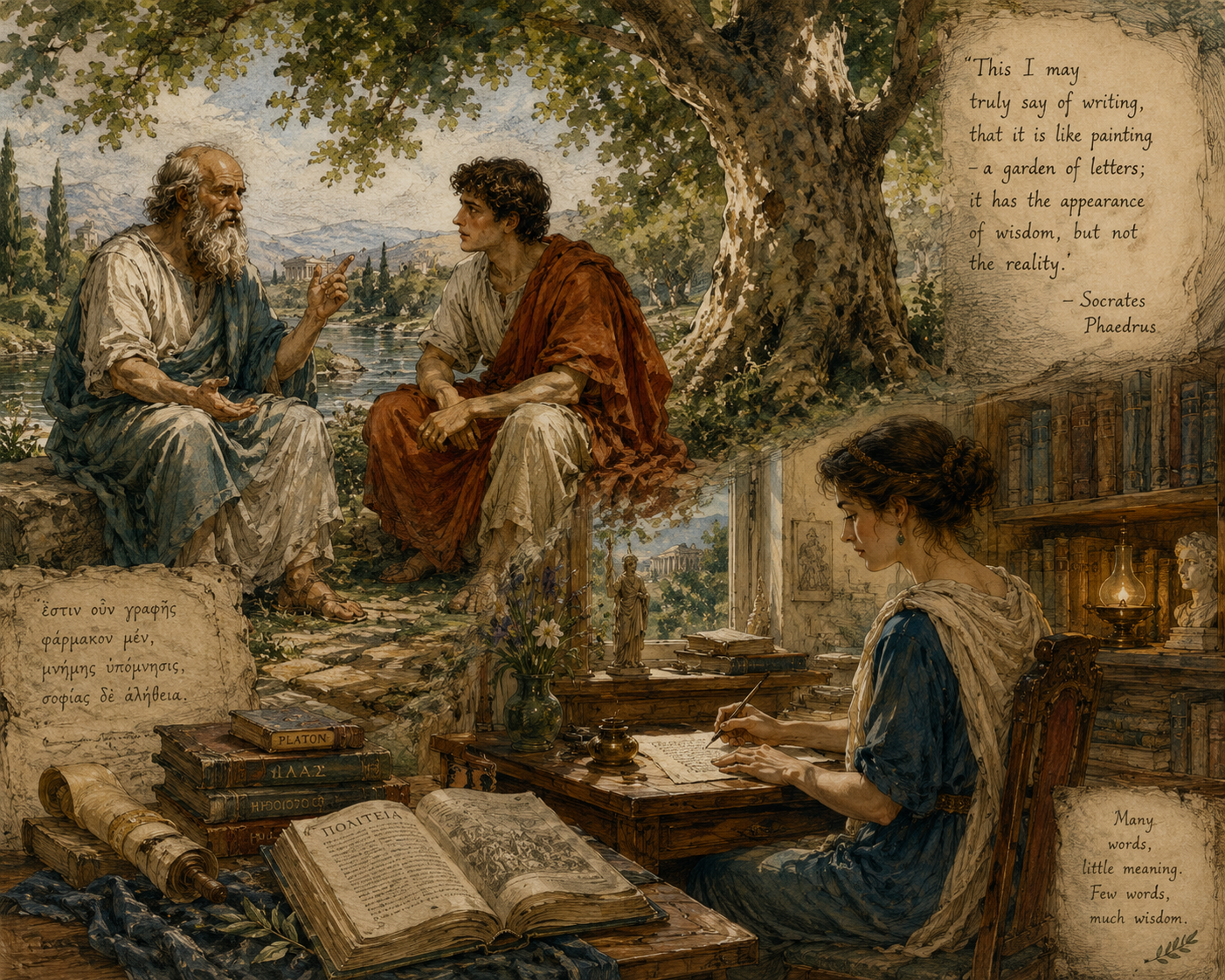
The tension between Plato’s antique view of writing as secondary to rhetoric, and our modern day obsession with writing via social media. Author’s own AI generated image.
“We are all writers now,” is a phrase that comes to mind. In this post-modern age of smart little tools and instant platforms upon which to make our voices heard, our world is increasingly at the mercy of the written word gone rogue.
“Going rogue” is not limited to just a mass of information being generated at any one time, but also touches on the deeper point Socrates makes to Phaedrus about accountability for words:
“And when they have been once written down they are tumbled about anywhere among those who may or may not understand them, and know not to whom they should reply, to whom not: and, if they are maltreated or abused, they have no parent to protect them; and they cannot protect or defend themselves.”
On the one hand, we have an overabundance of supply with social media, which is resetting the amount of information we can readily absorb, and more importantly reducing our attention spans. On the other side of this poison coin, the rise of AI raises the question of who is accountable for writing what? And that situation will only become more entrenched and confusing particularly where it concerns plagiarism and copyright.
Then we come to Plato’s view as to the worthiness of writing as a serious or less serious pursuit – what he has Socrates describe as a “garden of letters.” This is where his argument for reminiscence and recreation alone comes in:
“He will write them down as memorials to be treasured against the forgetfulness of old age, by himself, or by any other old man who is treading the same path. He will rejoice in beholding their tender growth; and while others are refreshing their souls with banqueting and the like, this will be the pastime in which his days are spent.”
At the core of this dialogue is the idea that writing can only prove itself worthy if it is put to the test of dialectic, meaning that, if a person can argue their case through the spoken word more convincingly than their written composition, then they have proven themselves to be more than just a poet or orator, but a true philosopher. Plato here is saying that writing is best when it is served through understanding, memory and lived experience, pointing back to what Thamus tells Theuth that writing serves as an external compendium to reminiscence, and not to truth.
As an accomplished writer more so than the spoken word, this renders me unqualified for the regal title of Philosopher!
I don’t think Plato dismisses writing in itself, rather that he treats it as inferior to the art of speaking. My own view is that the two go nicely together, and if someone is blessed to perform both flawlessly, then that is their gift to the world.
For me, writing will always be the place where I go to express my ideas, construct stories, and convey my own understanding and interpretation of the past with all its glories and pitfalls. It is my own little garden where I sow and tend thoughts, even if I never quite rise to Plato’s test of the philosopher.
* Quotations from Phaedrus are from Benjamin Jowett’s translation, Canterbury Classics.