Vanity and the Written Word
Yesterday, I wrote a piece on the relevancy of Writing as seen through the prism of two ancient Egyptian gods, Thamus and Theuth, in Plato’s Phaedrus - Writing and Reminiscence.
Today I came across an essay by Michel de Montaigne on the vanity of writing. What caught my eye is that his argument supports that of Thamus, king of Egypt who rebuked the inventor-god, Theuth, with his gift of letters, declaring that writing would not make men wise but only give them the appearance of wisdom.
Montaigne writes during the period, 1572-1592, nearly 1900 years after Plato, and he identifies times of excess as contributing to the laziness of people.
Montaigne argues that people have too much time on their hands and write needlessly. He doesn’t hold back on including himself in this assessment, never shying away from the reasons he is writing his own works, being that of self-indulgence.
He cites the Roman emperor, Galba, (68 – 69 AD), who declared that everyone should be held accountable for their actions, but not for their free time. Montaigne disagrees, stating:
“The Law ought to impose restraints on silly useless writers as it does on vagabonds and loafers.” (tr. A.A. Screech, Penguin Classics).
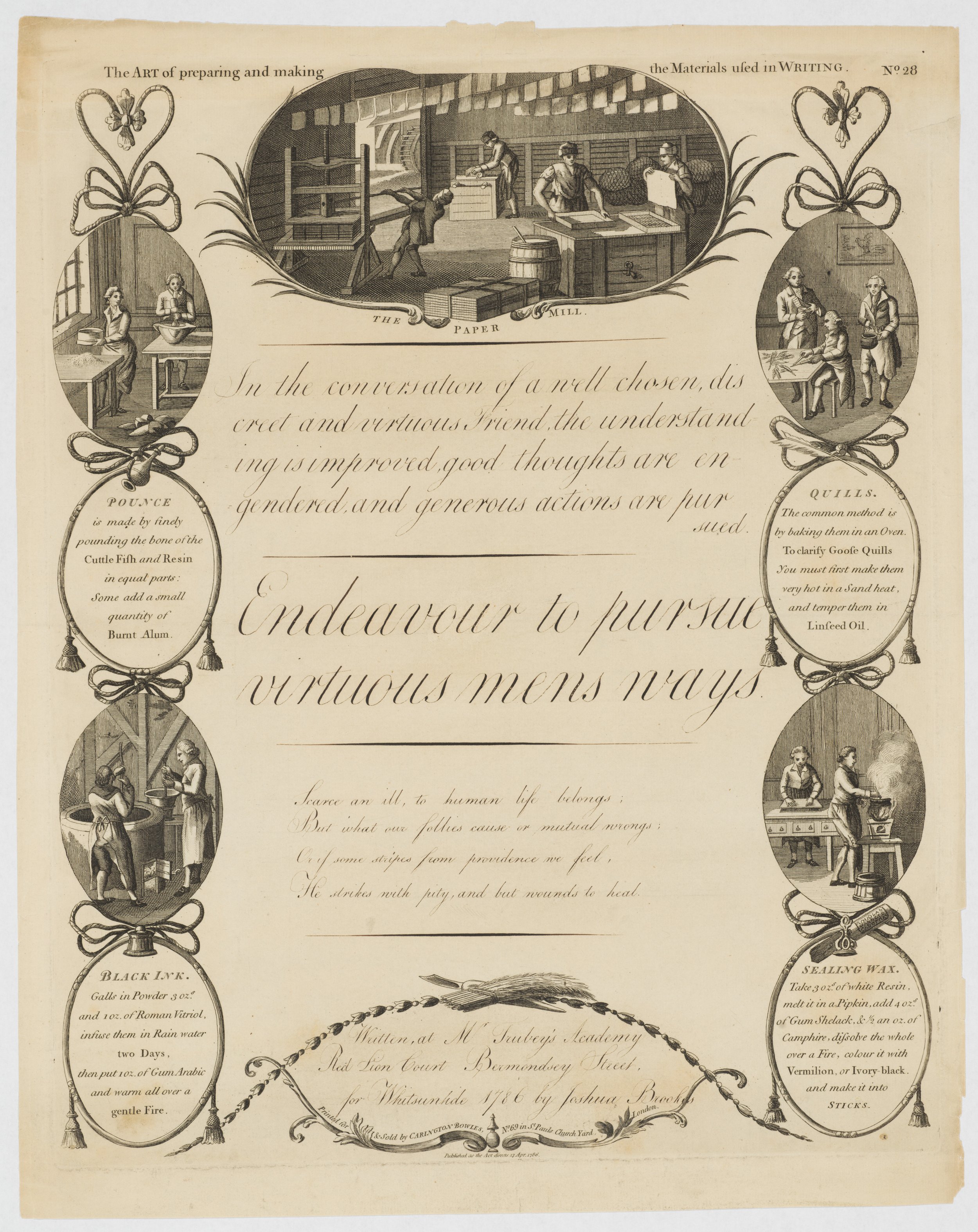
The Art of Preparing and Making the Materials used in Writing [School piece or Penmanship sheet]. Publisher: Carington Bowles I, 1724–1793. Calligrapher: Inscribed text by Joshua Brookes, 1786. Image courtesy of MET.
* See below for a full description of image.
He declares that scribbling has become one of the symptoms of the age of excess, posing the question of when did they ever write so much since the beginning of their Civil Wars, and likewise, the Romans just before their collapse?
Sound enough questions, but for those of us living these thousands of years later with access to a plethora of devices and an unquenchable thirst for having our say, this proposition seems ludicrous. How would we ever survive such savage eradication of thought and words?! Now, that’s a loaded question, and will remain to be covered for another essay.
But there is truth to what Montaigne argues: just because we have unfettered access, doesn’t mean our contributions are more worthy as they could be with far less means and capacity:
“Apart from the fact that to make minds more refined does not mean that a polity is made more wise, such busy idleness arises from everyone slacking over the duties of his vocation and being enticed away.”
He would no doubt be aghast at the arrival of social media in a thousand years’ time. It is a far cry from the seventeenth century where they were innovating ways to make and prepare materials for writing, which would lead the way to printing presses and access to writing tools for all people - hence, the image I’ve used to demonstrate the impact writing has had on our world.
What Montaigne says next cuts the deepest, as it goes straight to the heart of our contemporary age where, people and governments alike, seemingly ignore boundaries and treat life as having a carte blanche ticket to endless fun and frivolity, making no consideration for unexpected catastrophes, and unwilling to see our own roles in the great play of life:
“Each individual one of us contributes to the corrupting of our time: some contribute treachery, other (since they are powerful) injustice, irreligion, tyranny, cupidity, cruelty: the weaker ones like me contribute silliness, vanity and idleness. When harmful things are compelling then, it seems is the season for vain ones; in an age when so many behave wickedly it is almost praiseworthy merely to be useless.”
If that does not diagnose our own age, what would?
We in the West today are living through a massive shift to our way of life, economically, psychologically, culturally, and spiritually. All happening in real time, and quickly. It is as if we have no levers to control the speed at which things are changing, nor the willpower to do so as we see successive governments across most western nations, sacrifice honour for selfish personal gain, leaving their societies in chaos and confusion.
The year 2020 marked the pivot. Six years on, we live under deepening surveillance as a measure of control by political leadership. As I read through the classics, from Antiquity to the early modern period, it is undeniable that striving for, achieving, and preserving a state of individual liberty, is an anomoly, rather than the norm.
Yet both Montaigne and the ancients would urge us to write anyway, not from vanity, but from duty to the past and to the future. Consider what Livy writes:
“The study of history is the best medicine for a sick mind; for in history you have a record of the infinite variety of human experience plainly set out for all to see; and in that record you can find for yourself and your country both examples and warnings; fine things to take as models, base things, rotten through and through, to avoid.”
Titus Livius (Livy) wrote this in the preface to his work, The Early History of Rome, composed at another great turning point in time: late first century BC – early first century AD, and during the time when ancient Rome had evolved from republic to empire.
Quotations from Montaigne are from A.A. Screech’s translation, Penguin Classics; Livy are from Aubrey De Sélincourt, Penguin Classics.
*This print is decorated at the top and sides with small scenes that show men working in a paper mill, making pounce, black ink, sealing wax and examining quills. Moral verses at center were added in pen and ink by Joshua Brookes, a student at Mr. Trubey's Academy, Red Lion Court, Bermondsey Street, London (see 26.28.802 for another sheet signed by Brookes in 1783).
The work comes from a genre known as writing sheets, writing blanks, penmanship exercises, letter sheets or school pieces, published in Britain ca. 1660 to 1860 and used by students to demonstrate their handwriting abilities.