Brutus of Troy - What’s in a Name?
Dispatch from Troynouant.
‘For noble Britons sprong from Troians bold,
And Troynouant was built of old Troy’s ashes cold.’
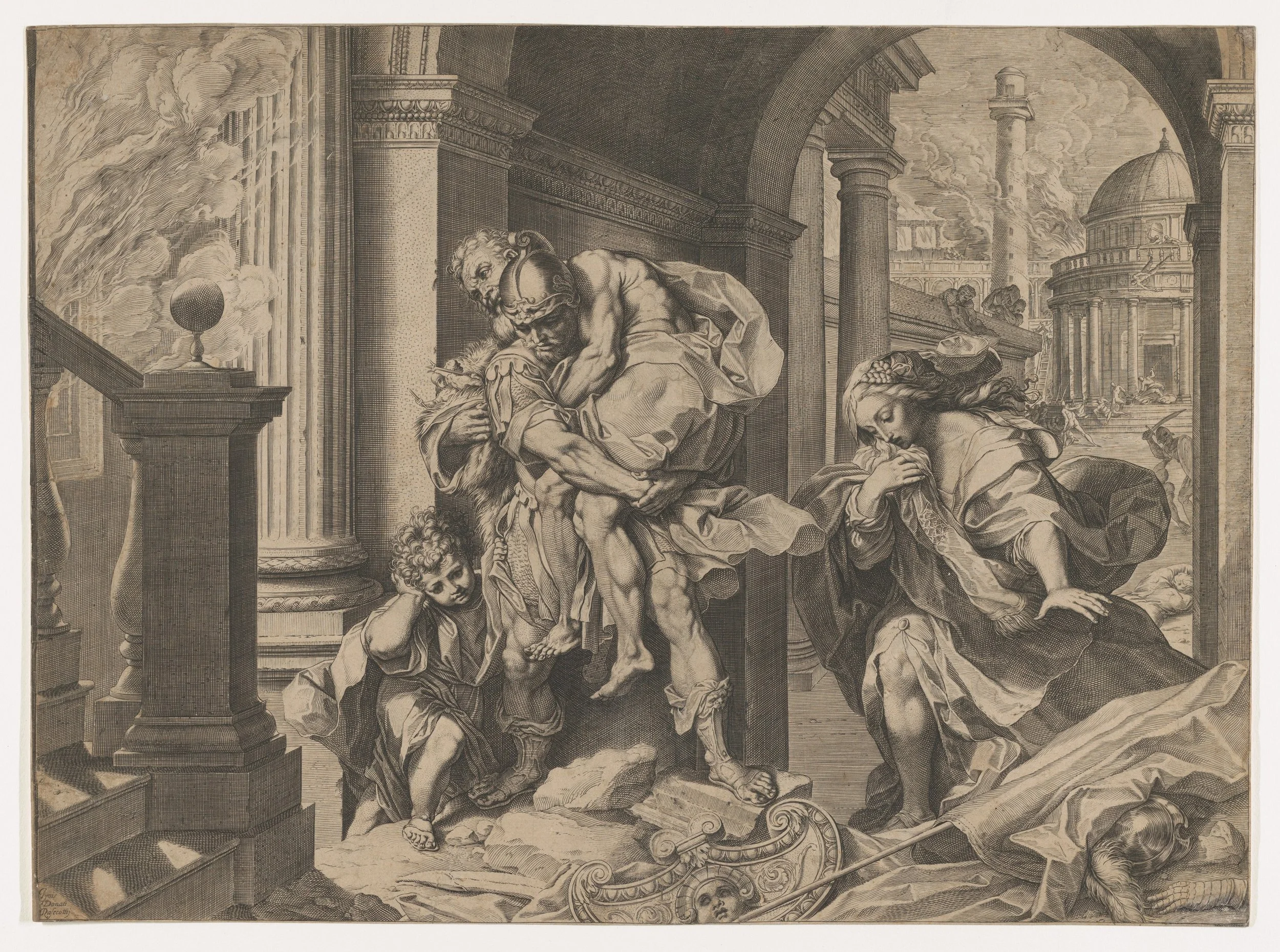
Aeneas and his family fleeing Troy. 1595. Artist: Agostino Carracci (Italian, Bologna 1557–1602 Parma); Artist: After Federico Barocci (Italian, Urbino ca. 1535–1612 Urbino). Image courtesy of the MET.
Reflecting on the political and cultural anxieties that Great Britain is currently experiencing, my thoughts have turned back some 3000 years to the flight of Aeneas from the ruins of Troy, eventually landing on the shores of Latium to found what would become one of the greatest civilisations in history – Rome.
You may wonder how these two events, so long apart, are connected. As it turns out, very much so if we trace the timeline according to England’s mythical history. You may then push back against the mythical component; fair enough, but I would propose that much of what we know of the ancient world is grounded in myth, legend and stories that have been carried through thousands of years of retelling, not to mention the interest and intrigue they continue to ignite in we moderns.
The story grew in stature from John Milton’s, History of Britain, published in 1670, with a key focus on the ancestral link to Aeneas of Troy. His principal authority was Geoffrey of Monmouth who wrote a history of Britain in the twelfth century – The Historia Regum Britanniae. This was apparently based upon translations of ancient British texts – Bulfinch’s Mythology cites these originating from exiled Britons living at the time in Brittany.
Milton did not fully embrace this tale, but he premises its mythological origins of legitimacy this way:
‘…descents of ancestry long continued, laws and exploits not plainly seeming to be borrowed or devised, which on the common belief have wrought no small impressions; defended by many denied utterly by few.’
In other words, we humans love to cling to foundation myths.
A brief summary of Milton’s retelling.
Brutus is the great grandson of Aeneas, who fled the burning ashes of Troy, an event traditionally dated to 1184/3 BC.
When out on a chase one day, Brutus accidentally killed his father, Silvius, with an arrow and was subsequently banished, seeking refuge in Greece.
He discovered a community of Trojans living under the oppression of the local king, Pandrasus. Brutus became their leader and, rather than endure slavery, they withdrew into the woods and challenged his authority, declaring they would ‘live a savage life rather than a slavish one’ and, if denied that, would depart for another land. In the end the king yielded: he granted them leave to go, provided them with ships, and gave his daughter, Imogen, in marriage to Brutus.
The exiled Trojans departed and eventually arrived at an island that seemed deserted, save for the ruins of a temple to Diana. There, after sacrificing and invoking the goddess for guidance, Brutus fell asleep within the temple and woke from a vision in which an oracle directed his next move:
‘Brutus! Far to the west, in the ocean wide,
Beyond the realm of Gaul, a land there lies,
Seagirt it lies, where giants dwelt of old;
Now, void, it fits thy people: thither bend
Thy course; there shalt thou find a lasting seat;
There to thy sons another Troy shall rise,
And king be born of thee, whose dreaded might
Shall awe the world, and conquer nations bold.’
The legendary Faerie Queene.
Divine guidance led the band of exiled Trojans to finally land on the shores of Britain – known then as Albion, a land once dominated by giants, but who the Trojans eventually exterminated. Brutus built a new capital city and named it Troynouant, the place known today as London.
The sixteenth century poet, Edmund Spenser, wrote an epic poem, The Faerie Queen, presented as a moral and political allegory wherein virtue is held up as the goal for every fine gentleman to attain, and was dedicated to Queen Elizabeth 1.
It speaks of haunting echoes from time past and potentially, future time. I have chosen just three short passages to reflect the intrigue of how this story relates to the legendary Aeneas of Troy:
On the wonder of and connection to Troy:
‘Troy, that art now nought , but an idle name,
And in thine ashes buried low dost lie,
Though whilome far much greater then thy fame,
Before that angry Gods, and cruell skye
Upon thee heapt a direfull destinie,
What boots it boast thy glorious descent,
And fetch from heauen they great Genealogie,
Sith all thy worthy prayses being blent,
Their of-spring hath embaste, and later glory shent.’
Britomart – Spenser’s allegorical warrior of virtue and all that represents the Elizabethan monarchy as national protector – on learning of her Trojan heritage, expresses deep longing for her own genealogy connecting to Troy:
‘Whenas the noble Britomart heard tell
Of Troian warres, and Priams Citie sackt,
The ruefull story of Sir Paridell,
She was empassiond at that piteous act,
With zelous enuy of Greekes cruell fact,
Against that nation, from whose race of old
She heard, that she was lineally extract:
‘For noble Britons sprong from Troians bold,
And Troynouant was built of old Troyes ashes cold.’
Later in the Canto, a prescient warning of the future:
‘The glory of the later world to spring,
And Troy againe out of her dust was reard,
To sit in second seat of soueraigne king,
Of all the world under her gouerning.
But a third kingdome yet is to arise,
Out of the Troians scattered of-spring,
That in all glory and great enterprise
Both first and second Troy shall dare to equalise.’
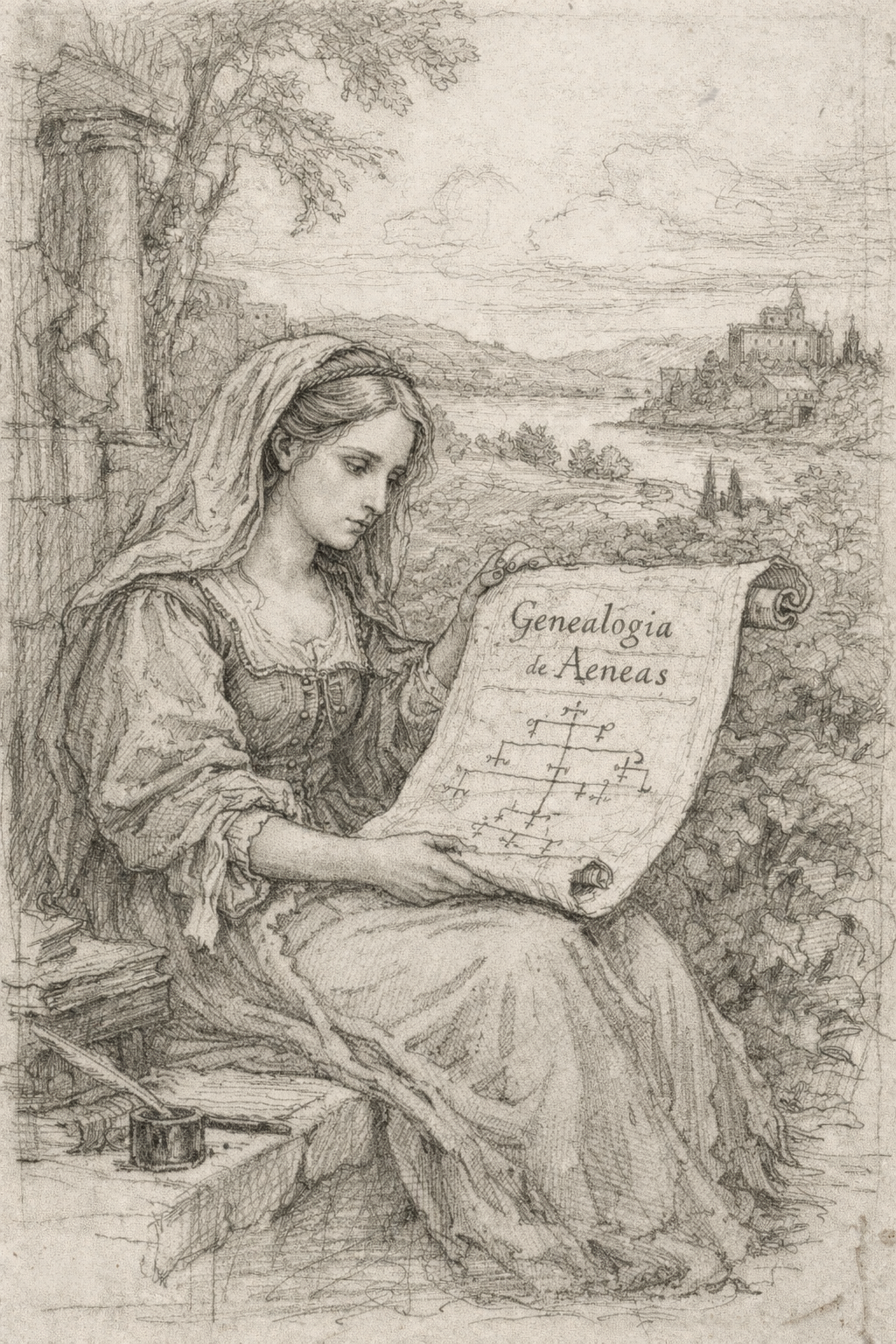
Britomart – Spenser’s allegorical warrior of virtue and all that represents the Elizabethan monarchy as national protector – on learning of her Trojan heritage, expresses deep longing for her own genealogy connecting to Troy.
The rhythmic parallels of time.
The parallel to the burning Troy is a metaphorical reflection of the tensions and uncertainties creating a real sense of fear and gloom for many Britons today. Yet not just Britain: all western nations are being tested through enormous pressure with debt, endless immigration, weak leadership, and a restless populace that has lost trust in the institutions that were designed to serve the people’s interests, but which now appear to do the opposite.
Rather than the escape from burning cities, Britain’s population remains. Yet it persists as a story of destruction and potential renewal: defending and preserving what was built through adversity, grit and perseverance.
Myths like Brutus endure as ballast, helping people grasp their history and what made their nations flourish – just as Milton defends the legitimacy of “descents of ancestry long continued…”
What’s in a Name?
There is another intriguing angle: the name of the man who made these stories legendary – Brutus.
Most people know this name as the man who led the assassination of Julius Caesar in 44 BC, but our Brutus of Troy has suffered a loss of general recognition, surviving mainly among classicists and medievalists.
My argument is twofold – on one hand we have the evergreen story of destruction and rebirth; on the other we have a case of, “What’s in a name?” One is tempted to ask the question, “Et tu, Brute?” Both relate to a common genealogy in Britain’s mythical origins to Ancient Rome.
1184/3: Destruction forces the abandonment of Troy. Rebirth establishes a New Troy in Rome. Brutus, exiled from that New Troy, lands in Albion to build a second New Troy.
509 BC: The Roman monarchy collapses under the reign of brutal tyrants. Our second Brutus becomes one of the first two consuls of a Republic.
44 BC:
Our third Brutus leads the assassination of Julius Caesar who aspired to kingship, the very institution that his ancestor helped to dismantle in 509 BC.
The name Brutus attaches itself to moments when a political order ends and a new one begins. Across a millennium of storytelling and history, Brutus becomes the name that signifies the making, unmaking, or refusal of kingship.
Every Brutus stands at a moment of profound change. One founds a monarchy, one destroys a monarchy, and one murders the very aspiration to monarchy.
Does Brutus linger in 2026?
Fast forward to 2026 and Rupert Lowe, leader of Restore Britain, committed to reclaiming Britain for the British, and leading in the opinion polls, appears an unstoppable force as he draws both praise and ire from friend and foe alike – all the regular hallmarks of regime change at any point on the timeline of history. Of course, unless Rupert Lowe’s middle name is Brutus, the connection to names ends with Caesarian Rome!
Every great story must be laced with intrigue, steeped in legend and myth – something largely abandoned by the modern world, and with it a vital layer of identity and heritage. Joseph Campbell, in The Hero with a Thousand Faces, writes that the centre of gravity in the realm of mystery and danger has shifted, and that it is now man himself who has become the crucial mystery. I argue that we always were; it is only now that our fully exposed egos have been brought forth into the light of day – for good or bad.
Great Britain’s current intrigue evokes destruction and rebirth. While we know the outcome of the first two New Troy legends, the third is yet to be played out.
As a fifth-generation Australian, with much of my ancestry deeply rooted in Britain, I look forward to a rising of “old Troy’s ashes cold.”
Let the voices of the past speak, and timeless civic wisdom prevail!