Ancient Customs & Men of Might
‘The greatest power allowed to a magistracy by the Senate according to Roman custom: to prepare an army, to wage war, to coerce allies and citizens by every means, and to wield the highest command and jurisdiction at home and on campaign.’
This passage from Sallust refers to the commitment the ancient Romans had to protecting the Roman Republic at all costs.
The important reference here is to “custom,” rather than to any legal basis granted to the man who would wield such power. This distinction forms the basis of my argument that there was more to the degradation of the Roman Republic than just the cyclical nature of change. The ballast supporting the whole edifice was crumbling. And we today can learn so much from their experiences.
Looking in the rear-view mirror
The world is in chaos. Our nations are under threat with decay from within the most insidious danger.
We are losing our grip on how to stabilise the shifting sands beneath us.
Civilisations rise and they fall. This is not a new phenomenon. It is a pattern repeated throughout time. Yet, despite direct access to the playbook of how to avert disasters, we continue to allow the cycle to repeat.
Perhaps therein lies the problem – information overload. Instead of accessing exactly what we need to avoid the implosion, we seem unable or unwilling to find it within the dense forest of words and signals.
The Roman Republic had a solution for such chaotic times – it appointed a dictator to protect against external threats of war and to counter civil crises.
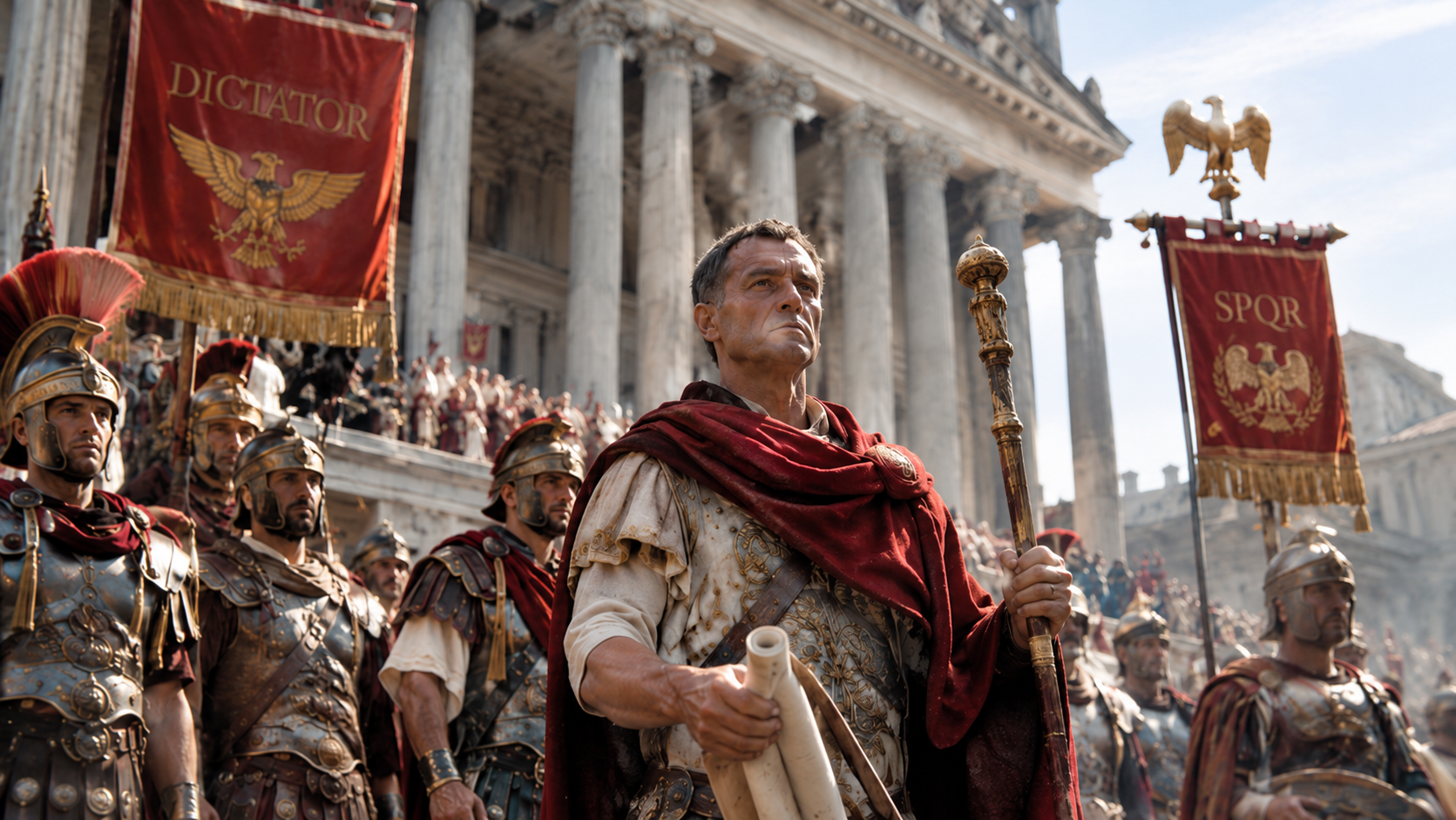
While the word “dictator” sends shivers through the veins of any liberty-minded person, it must be regarded within the context of the times. In the Roman Republic, the office served as a safety mechanism, and yes, it was an “office” in the constitutional sense, as Dio Cassius writes:
‘Dictator was the name given to the man honoured with this position, and he possessed power equal in all respects to that of the kings. People hated the name of king on account of the Tarquins, but desiring the benefit to be derived from sole leadership, which seemed to exert a potent influence amid conditions of war and revolution, they chose it under another name.’
His powers, while extensive, were not unlimited. He had six months to restore order before stepping down, and possessed no ability to change the constitution – although there are some cases where ancient historians consider that this was done or attempted.
The office fell into disuse following the end of the second Punic Wars in 202 BC, partly due to a more subdued civil environment, and changes to military campaigning that saw several capable commanders continue to conduct wars rather than relying on just one with overriding powers.
What was the replacement?
Without this emergency brake, how did Rome deal with any future “frightening business” as Sallust puts it?
Through senatorial decree – Senatus Consultum Ultimatum (SCU). More power was now placed in the hands of the senators rather than solely in that of one man.
The dictatorship remained dormant for the next 120 years before Sulla revived it in 82 BC, followed by Julius Caesar in 48 BC, both of whom pushed the boundaries of the traditional office.
So, why did it work well for the first 300 years and then descend into cruelty under Sulla and abuse under Caesar?
As mentioned at the start, civilisations are subject to cycles – the ancient Greeks referred to this as Anacyclosis. It is the same for individuals – as we rise from the depths of poverty and despair to the heights of comfort and convenience, any deeper meaning to life is often lost. We moderns have enjoyed such comforts during the past century.
I argue, however, there is a bit more to it than just this. It has to do with the past and its role in building strong societies. It is a sense of tradition that acts as the ballast. It holds societies together, and can only give way when we forget who we are, where we came from, and what we stand for.
The Romans referred to it as “mos maiorum” – the way of the ancestors. It underpinned everything that the Republic embodied. Cicero writes of it succinctly:
‘For neither men alone, unless a State is supplied with customs too, nor customs alone, unless there have also been men to defend them, could ever have been sufficient to found or to preserve so long a commonwealth whose dominion extends so far and wide.’
While the Roman constitution was not written down, the dictatorship was subject to both formal and informal constraints: formal through the law, informal through tradition.
The case for tradition
But the office itself was not enough. Its effectiveness depended upon the customs that restrained the man who held it. It was this honouring of tradition that enabled the office to continue to function reasonably well through the first 300 years.
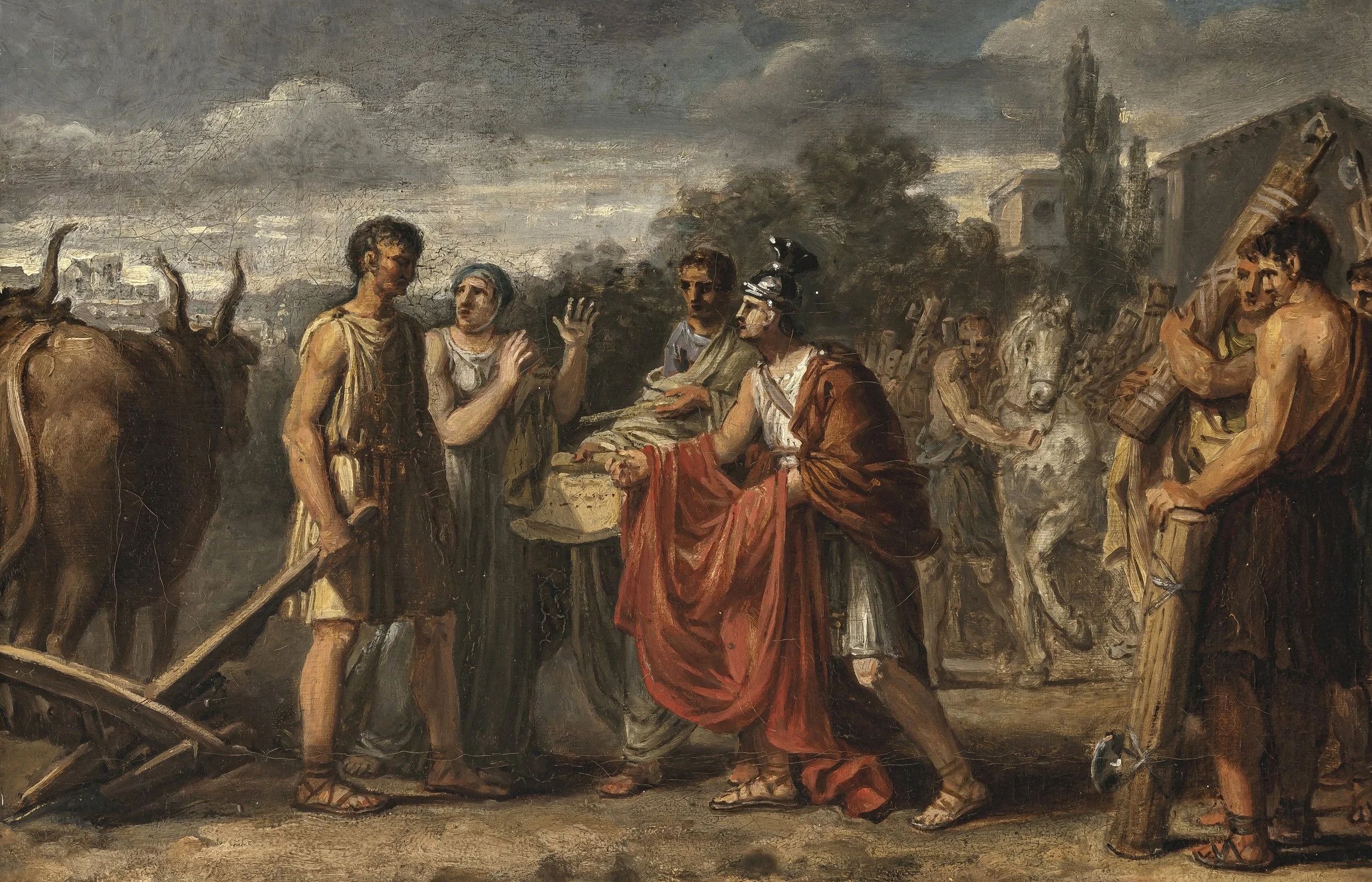
Lucius Quinctius Cincinnatus is summoned from his plough to serve as dictator (after Livy, III.26). A plaque on the reverse bears the inscription “Quinctius Cincinnatus”. Oil study on canvas. 31.5 × 48 cm. 17th century. Image courtesy of Wikimedia Commons.
When Cincinnatus left his plough to take on the role of dictator to rescue beleaguered Roman troops from the Aequians in 458 BC, and when Camillus was called out of exile to save Rome from the Gallic invasion of 390 BC, it wasn’t the law that drove them as much as their commitment to Rome. They possessed something that generations of the late Republic had lost – a reverence for mos (tradition). It is the reason that the office was not subject to the perversities overseen by Sulla and Caesar.
In times of old, alliances were important; how one was perceived in life afterward weighed on those called to make tough decisions. Earlier dictators had set a precedent which was largely honoured, so those following them were obligated to live up to that same standard for the sake of an exemplary life.
By the time Sulla revived the dictatorship, there was little honour to be observed. Fifty years prior, the conflicts surrounding the revolutionary Gracchi brothers, who defied the Senate over social reform, marked the beginnings of ferocious internal strife. Together with the bitter rivalry that had raged between Sulla and Marius during the early 80s BC, produced what we today refer to as insidious identity politics.
Sulla was unforgiving in the changes he made to the constitution, ensuring the Senate was strengthened while weakening powers of the Tribunes, who represented the people. And he was brutal in the punishment of his enemies. He honoured one traditional aspect of the office by voluntarily stepping down after restoring what he considered to be the fundamental elements of the Republic. Yet his use of the dictatorship set a precedent that would spell the end for the Republic when Julius Caesar assumed the office in perpetuity forty years later.
The past as mentor
While no modern liberal democracy would tolerate the installation of a dictator to “sort things out,” it does raise the question: what does a nation do when all available mechanisms for reform are not working?
Our democracies are on the verge of lying in ruins.
Certainly in Australia, the democratically elected government imposes one dystopian law after another upon a populace who feel helpless to prevent it as they wait for the next election in the hope for change. But with so much propaganda being thrown about by all parties in the running, people are left waiting and wondering whether they have the power to change anything at all.
Two things are required for a restoration of our own decaying nations – an overhaul of political institutions to better reflect liberal democratic values, and a reclamation of our past achievements as the ballast needed to rebuild and maintain our resilience against forces intent on destroying us.
References:
Sallust, Catiline’s War (trans. A.J. Woodman), Penguin Classics; Dio Cassius, Roman History (trans. Ernest Cary), Loeb Classical Library; Cicero, De Legibus (trans. Clinton Walker Keyes), Loeb Classical Library.