How Greek Tragedy Names the Protagonists of Destruction
‘The mortal who sacks cities and temples and tombs, the holy places of the dead, is a fool. Having given them to desolation, he himself meets destruction in time to come.’
- Euripides, The Trojan Women
This is what Euripides has Poseidon say in his tragic play, The Trojan Women. He was referring to the folly of mortals who consistently seek to destroy and plunder for the sake of power. The playwright names the Greeks and Trojans of 2,600 years ago in this instance, but his voice echoes to name us in our own time.
This quote captures the essence of the destructive nature of power.
Anyone who seeks to destroy a person or society and their defining values, will ultimately destroy themselves and everything they hold dear.
This is a universal pattern with a historical blueprint cemented from the beginning of time. Nation begets nation begets nation.
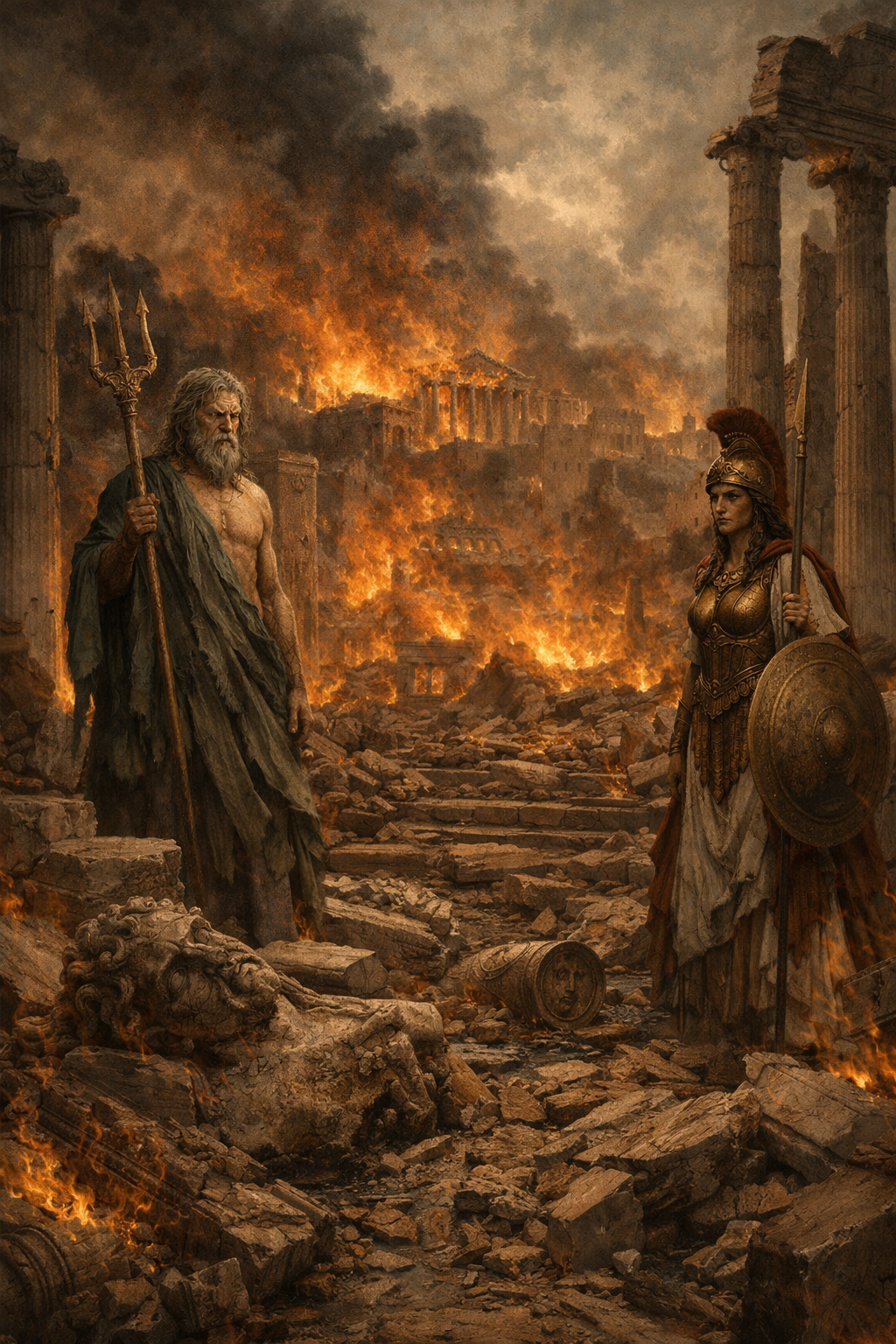
Recreated scene of Poseidon and Athena witnessing the Fall of Troy.
Troy fell to the Greeks.
Latium fell to the Romans.
Persia fell to the Macedonians.
The Roman monarchy fell to a republic.
The Republic fell to an empire.
The Empire crumbled into successor kingdoms.
Medieval Christendom rose, then fractured in violence.
Early modern empires and industrial nation‑states followed, spawning revolution and war.
Now we witness accelerating decay as a global conglomerate seeks a single world order, erasing sovereign nation‑states in its pursuit of power.
Does the man who visits ruination upon others not realise he is sowing the seeds of his own destruction?
The Trojan Women remains one of Euripides most poignant plays because its message crosses timelines relentlessly.
It highlights the vice of hubris in a way that exposes the defects of human nature while providing a lesson to posterity: in seeking to destroy others, the destroyer begins the process of his own decay.
It is not only relevant for those who lead nations; its role as a herald is instructive for every one of us. Through the mirror of showing how cities rise and fall, exposing the virtues and vices of all the inhabitants, it highlights individual natures and how we are all susceptible to the winds of fortune. It is how we react to the wind’s direction that matters.
A question I constantly ask in relation to the contemporary chaos occurring across Western nations as they battle the rise of tyranny is:
How will it benefit those making the rules designed only in their favour, while disenfranchising the populations, when many of us are dead or too sick to serve their egotistical needs?
Perhaps this is an existential question, but it is a very real one. The impacts from increasingly zealous authoritarian leadership and the draconian rules being made, are devastating to ordinary people.
Cost of living is the relentless antagonist in the lives of ordinary people. Once upon a time we were told to work hard and the rewards would be fruitful; the past decade has put a lie to that claim. Ever‑increasing regulations strangle any business that dares to make things work, taxes creep into the territory of the absurd, and a spreading apathy leaves many in utter despair, no longer knowing how to fix any of it.
It seems we cannot vote our way out of this mess, because whichever side gets in merely replicates the horrors of the last.
You can conquer cities, force people to live in fear, and surveil them until they can hardly breathe, but you will never secure your holy grail of eternal control. People eventually reach a breaking point. Ancient Greek tragedy has not decomposed under the ravages of time; it still names us as clearly as it named the Greeks and Trojans 2,600 years ago.
Quotations for Euripides ‘The Trojan Women’ is from James Morwood’s translation, Oxford World’s Classics.