Tulliola - Daughter of Rome and of Cicero.
The adored daughter of Rome’s greatest orator and politician.
She died too young, leaving a grief-stricken father to mourn her passing with an overwhelm of emotion that left his friends puzzled at his tortuous level of suffering.
This was Rome. It simply would not do for a man of his standing to be seen grieving to such an extreme.
‘Remember that you are Cicero,’ his friend, Servius Sulpicius Rufus, reminded him.
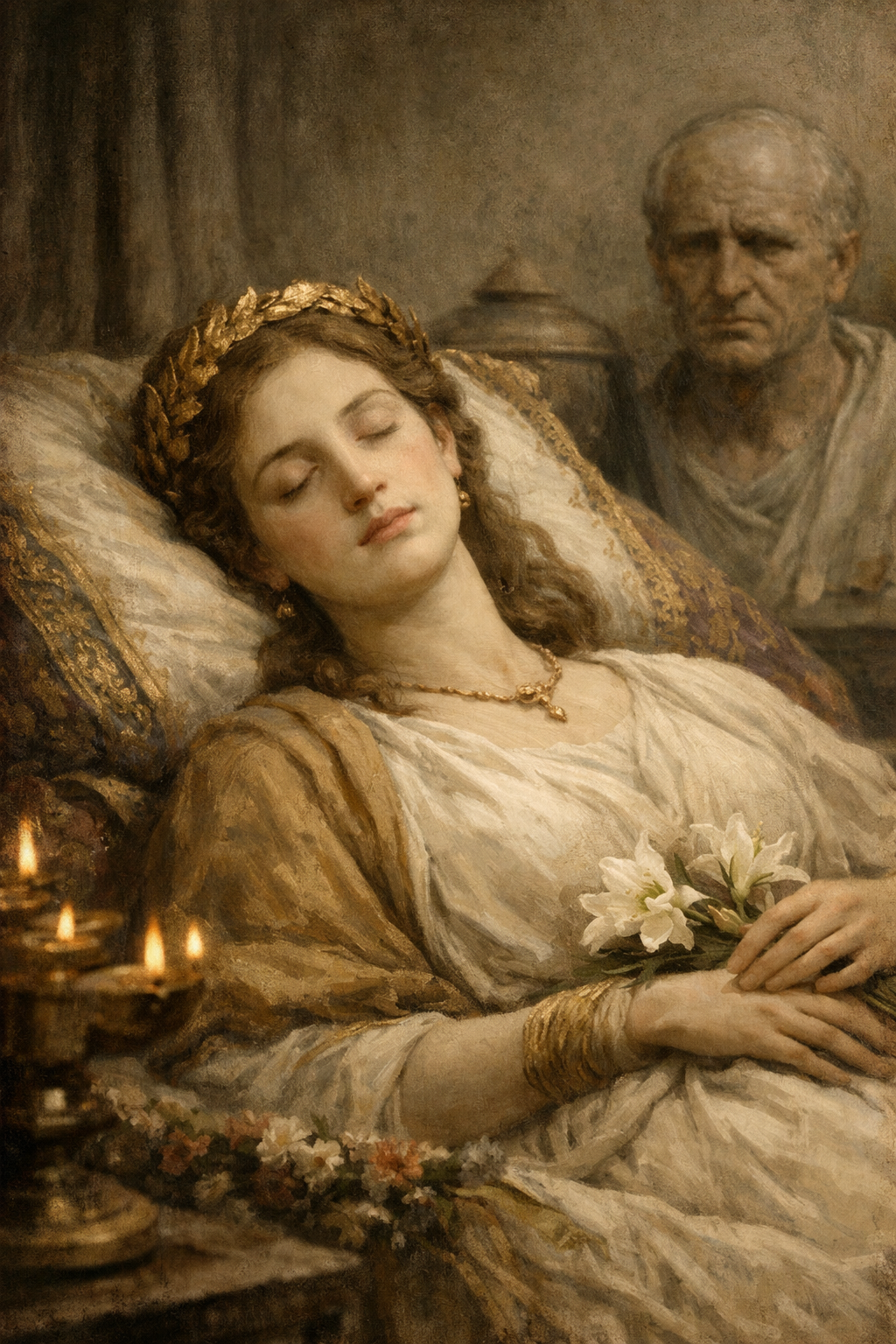
A poignant recreated image of Cicero’s profound grief over the death of his daughter, Tullia in 45 BC.
‘There is no grief that is not lessened or softened by the passage of time. For you to wait for this time to pass, instead of anticipating the result by your own good sense, does you discredit.
‘Listen then for her dead sake, for the sake of others…and for your country’s sake.
‘…do not let anyone suppose that it is not so much a daughter you are mourning as the public predicament and the victory of others.’
History is dominated by the momentous exploits undertaken by great figures. Rarely do we gain insight into the very intimate lives behind the facades. Certainly, there is no shortage of stories involving scandals and skulduggery, but to gain a very real sense of how such commanding figures “feel;” how their hearts “beat;” that is rare.
Thankfully Marcus Tullius Cicero left to posterity many personal accounts through his own eyes. But none more revealing than that which epitomised the love for his only daughter upon her death.
A backstory worthy of understanding.
Cicero had a son and a daughter. He did his utmost to guide Marcus into the best man he could be, dedicating the work, On Duties, to his son in the hope that he would look to philosophy as a guiding principle through his life. Following the death of his daughter, Tullia, philosophy became Cicero’s consolation.
Tulliola, as he affectionately referred to her, married three times – her first husband died a year later; the second marriage ended in divorce; and her third broke down following the death of her two infant sons.
She died soon after.
Cicero’s poignant insight into the deep love he had for his family could also be interpreted as a reflection of the civil war that was ripping apart the other great love of his life – the Republic.
He wrote that he felt it ‘discreditable’ of him to not be able to bear his bereavement as so wise a man as Rufus considers it should be borne. He lamented the loss of his standing in politics through the brutal civil wars of the past years, writing to Rufus that he felt overwhelmed, and can ‘scarcely offer any resistance to grief, because I have no such solaces as others in similar plight.’ While “they” still entertained high honours, he compensated that loss through consolation of being with his family.
He had years earlier divorced his wife, Terentia; he remarried but it was short-lived. His son, Marcus, was away in battle, and it was Tulliola who was still there.
‘I had a haven of refuge and repose, one in whose conversation and sweet ways I put aside all cares and sorrows. Now this grievous blow has again inflamed the wounds I thought healed. When in the past I withdrew in sadness from public affairs, my home received and soothed me; but I cannot now take refuge from domestic grief in public life, to find relief in what it offers. And so I stay away from home and Forum alike, for neither public nor private life can any longer comfort the distress which each occasions me.’
We don’t consider the minutiae of how these great men felt on a personal level. In fact, I daresay most people would think they didn’t feel much at all. Our twenty-first century moral superiority we cling to of the view that we moderns are so much more evolved is crass and ignorant.
The ancients lived, laughed, fought, and cried just as we do, but with a big difference – they were more resilient in facing life’s slings and arrows.