The Brilliance of Cicero and Why He Matters Today
A lifetime could be spent eulogising or criticising Marcus Tullius Cicero, so vast is the material we have at hand.
I find the times we live in remarkably familiar to the lead up to the Roman Republic’s fall. To that end, I present here some insights from Cicero for my Readers to ponder, and determine for yourselves the presence of wisdom and warnings.
Cicero’s political life was full of ups and downs, triggered by fortune and misfortune – politically and personally. Despite being consul of Rome in 63 BC, and holding a successful and respected governorship of Cilicia in 51 BC, his high point, politically speaking, will be remembered as the time he began his crusade against Marc Antony, loyal lieutenant of Julius Caesar and now consul of Rome following the assassination of Julius Caesar in 44 BC.
Cicero composed a series of speeches, Philippics, with the aim to defend the ailing Republic from descent into tyranny as a result of Caesar’s perpetual dictatorship wrapped up in what Cicero viewed as his pursuit of kingship, and Antony’s own ruthless aims. With Caesar now gone, he turns his attention to the one man he sees as endangering the traditional system that he values.
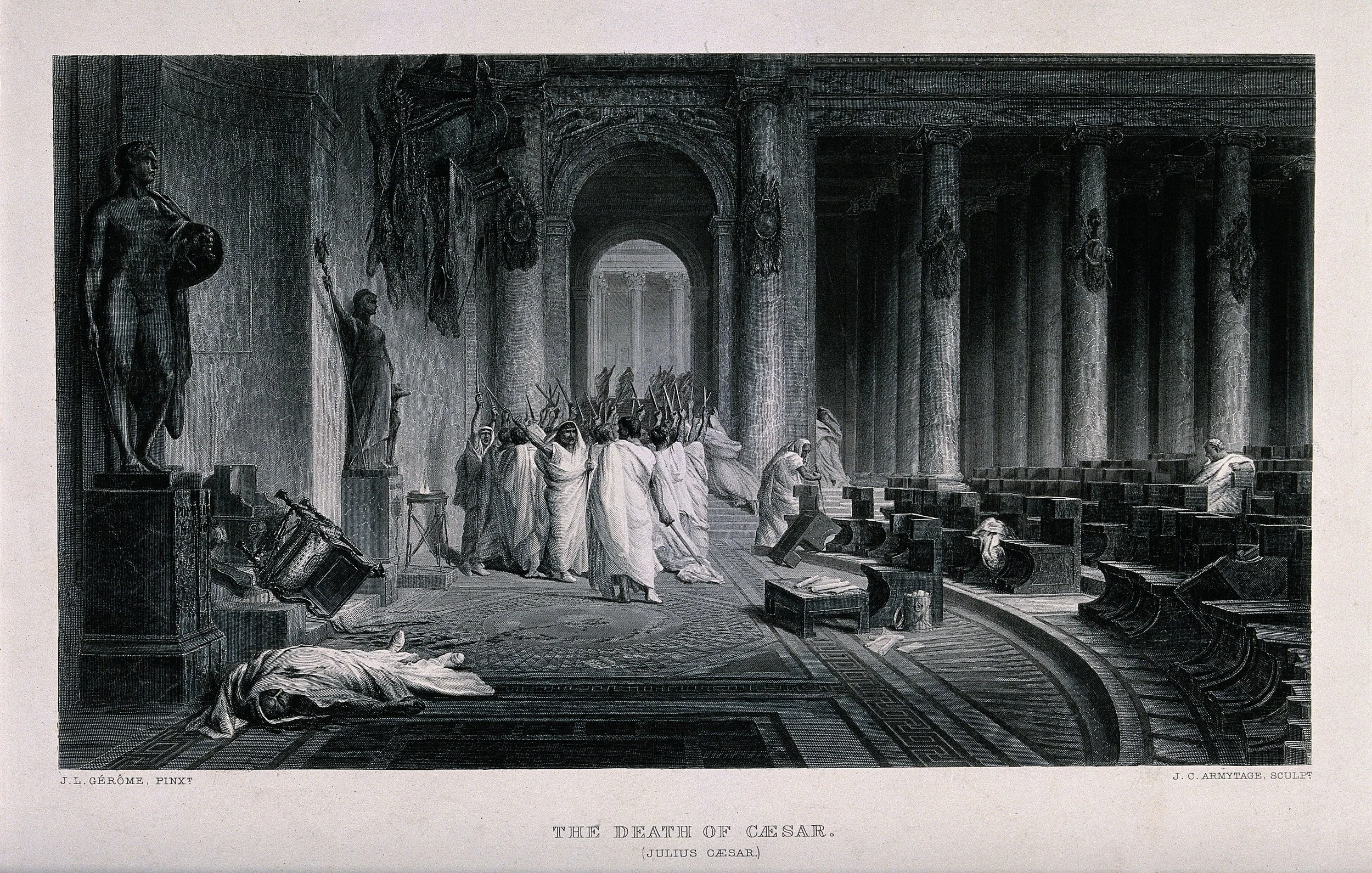
The death of Caesar: Caesar is lying on the ground, assassinated by a group of senatorial conspirators led by Cassius Longinus and Marcus Iunius Brutus on the Ides of March. Etching by J.C. Armytage after J.L. Gérome. Image courtesy of Wikimedia Commons.
The speeches that spelled the death knell for Cicero
There are fourteen speeches preserved in the series. Here I will address a small part of the second book, the reason being that this speech is by far the longest of the whole collection, but it is this last section I find tantalisingly relevant to what we are facing in the West today.
I begin with one of the final sentences of the entire speech which reveals Cicero’s motivation:
‘As for me, out of my own mouth I will make this declaration: I defended the Republic when I was young; I shall not desert it now that I am old. I despised Catiline’s blades; I shall not fear yours. Yes, and I should be happy to offer my body if my death can bring into reality the freedom of our state so that the suffering of the Roman people at length brings to birth what has so long been in the womb.’
After rigorously critiquing Antony’s failures and vices, he turns from the past and calls the Senate to the present. Due to his grip on the city, and the fear for his life from the conspirators who struck Caesar twenty-three times, Antony had surrounded himself with mercenaries for protection everywhere he went. When Cicero raised this insult, he asked was it not better to die a thousand deaths than be unable to live in your own city without armed guards, and reminded him of what Rome stood for:
‘You should be fenced around by the love and goodwill of your countrymen, not by weapons. The Roman people will take those weapons of yours from you, wrench them out of your hands; I pray that we do not perish in the process.’
Cicero elevates the dire situation that Rome now faces if liberty is not returned. He also reminds Antony that there are men who are prepared to take the helm if he insists on pursuing this road, stating that the Republic has “only so far avenged itself, not regained itself.”
He leaves open the prospect, and clearly in his own mind, the probability, that good men will step up when called upon, and cautions Antony:
‘Let them withdraw as much as they please out of concern for public tranquillity: the Republic will recall them.’
He then praises the conspirators for taking up their swords and slaying a tyrant, recalling the bravery of those in the early years of the Republic who also had to confront the threat of tyranny, naming the original Brutus who was responsible for ridding the monarchy of Tarquinius the Proud and becoming one of the first consuls of the new Republic.
A dire warning was issued:
‘Peace is tranquil liberty, servitude is the worst of all evils, one to be averted not only at the price of war but even of death.’
He then returns to Antony’s reliance on security through violence, reminding him that his followers will only tolerate so much, and poses the question of what sort of life is it to be afraid of one’s own followers, day and night.
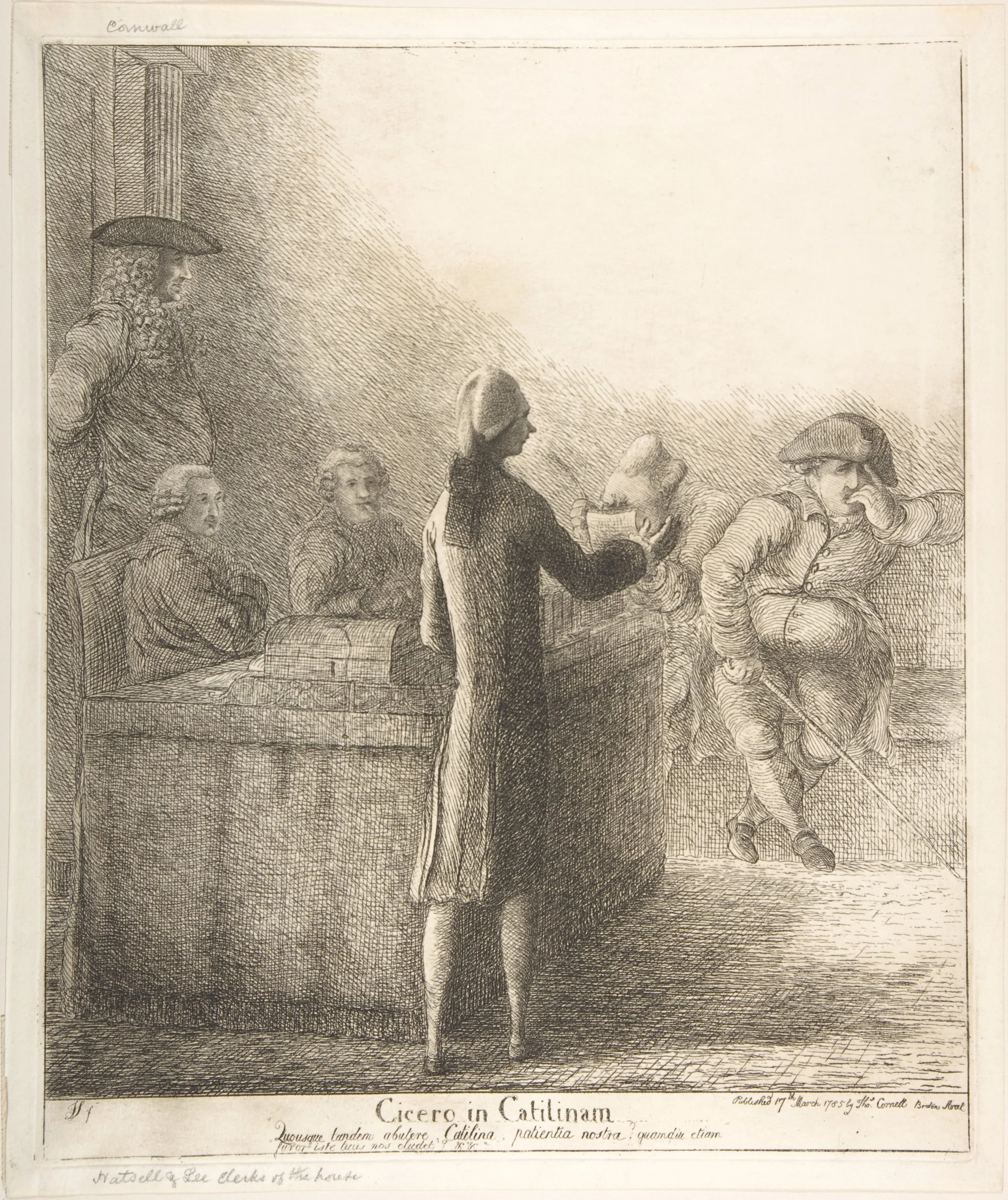
Cicero in Catilinam. Artist: James Sayers (British, 1748–1823). Publisher: Thomas Cornell (British, active 1780–92). London 1785. Image courtesy of the MET. * (See note below for full explanation of this image).
Remembering and Honouring the past
Despite Cicero celebrating the fall of Caesar as tyrant, he proceeds to draw comparison between the two, but only in so far as their lust for power went. They diverged when it came to intellect and strategy. Both Caesar and Cicero had enjoyed cordial relations and mutual respect for each other’s abilities. Cicero had once hoped for Caesar to turn from his authoritarian ways and become the leader he wished him to be – an ideal director.
One of the most cautionary pieces of advice next is revealing in its relevance for us today, part of which is metaphorical as it relates to us in contemporary times — that I am compelled to state this while writing of a time two thousand years ago when they were facing the threat of tyranny themselves, is an irony not lost on me:
‘But out of the very many evils that Caesar branded on the Republic this much good has nonetheless come, namely that the Roman people learned how much reliance to place on each person, whom to trust, whom to beware of.
Do you not reflect on this and understand that for brave men it is enough to have learned what a beautiful thing it is to slay a tyrant?
‘Will men put up with you, when they did not put up with Caesar?’
Cicero ends by urging Antony to look back upon the Republic and think of the men from whom he sprang instead of those with whom he associates.
The message here for us in 2026 is glaring. It is so bright that it could cause us all to faint if we dare to gaze at it directly: what have we learned from recent years of government using emergency powers and public fear as a political tool to impose measures such as mandatory injections and prolonged home detention, and what will we do when they attempt it again?
It may be the eleventh hour, and the institutions, governments, legal powers together with public compliance, may appear to have the advantage in their position to control us all, but humans must never vacate the field of battle for freedom. If we do that, then the outcome is sealed for good. And our descendants will never know that at least we tried to reclaim our right to think, speak and live as we please as long as we do no harm to another.
Cicero eventually died at the hands of Antony’s henchmen, his vengeance seeded by the speeches which were composed against him. The Republic was not saved, and the young man, Octavian, who became known as Augustus, went on to build the Roman Empire.
All quotes are translations by D. R. Shackleton Bailey, Loeb Classical Library.
NOTE: This speech was never delivered in the Senate due to Cicero’s fear for his safety following Antony’s bitter invective against him on 2 September 44 BC following Cicero’s First Philippic. It was prepared as a pamphlet to be spread beyond the Senate in an attempt to alert the people of Antony’s ill intentions, although some historians believe it was only circulated outside his own circle following his death.
* In November 1784, a year after King George III appointed him chief minister, William Pitt faced a general election that secured his claim to office. Here, he stands before the House of Commons, addressing his bitter rivals, Charles James Fox and Frederick Lord North, who squirm with anger at being forced onto Parliament’s Opposition Benches. Fox demonstrates disrespect by wearing his hat and chewing his fingers. North scowls and buries his head in papers. The printmaker expresses his admiration through the title which compares the youthful Pitt to Cicero, a statesman who preserved the Roman Republic by suppressing a coup d’état led by the patrician Catiline. Sayers has brilliantly reduced the complex rivalries driving British politics to a dynamic among three figures. Expressively, densely etched lines set the scene in a half-light suggestive of moral darkness. (From MET site.)