The Lives Our Parents Lived Without Us
A reflection on the unknowable years our parents lived before we ever entered their story.
A great tragedy of life is that children never get to know who their parents truly are as individuals. Permission is only granted through the lens of a parent-child relationship, something that denies us the fullness of appreciation for the whole person.
When it comes their time to depart this world, we also have to confront the fact that we don’t have exclusive insight into their lives. How can we? We never truly knew them fully. But we can learn the most important lesson of all in this world, one that Roger Scruton, the conservative philosopher and writer, summed up succinctly:
‘Coming close to death you begin to know what life means, and what it means is gratitude.’ (Acton Institute – On the Meaning of Life).
We each get the opportunity to analyse our own lives from our earliest memories through to our last breath, but we are denied the chance to truly know the people our parents were before we came into existence. In many ways, that’s a puzzle with missing pieces.
It is only on experiencing that sense of gratitude that we realise the world doesn’t revolve just around us. It’s part of the life cycle that we lack the capacity to consider life beyond our own direct realm and narrow lens, but it’s a rude shock when we finally do realise it.
Perhaps this is not the story for everyone, but it is a perennial story told throughout Time, through oral storytelling, figure drawings, historical annals, myths and legends, personal letters, and epigraphs.
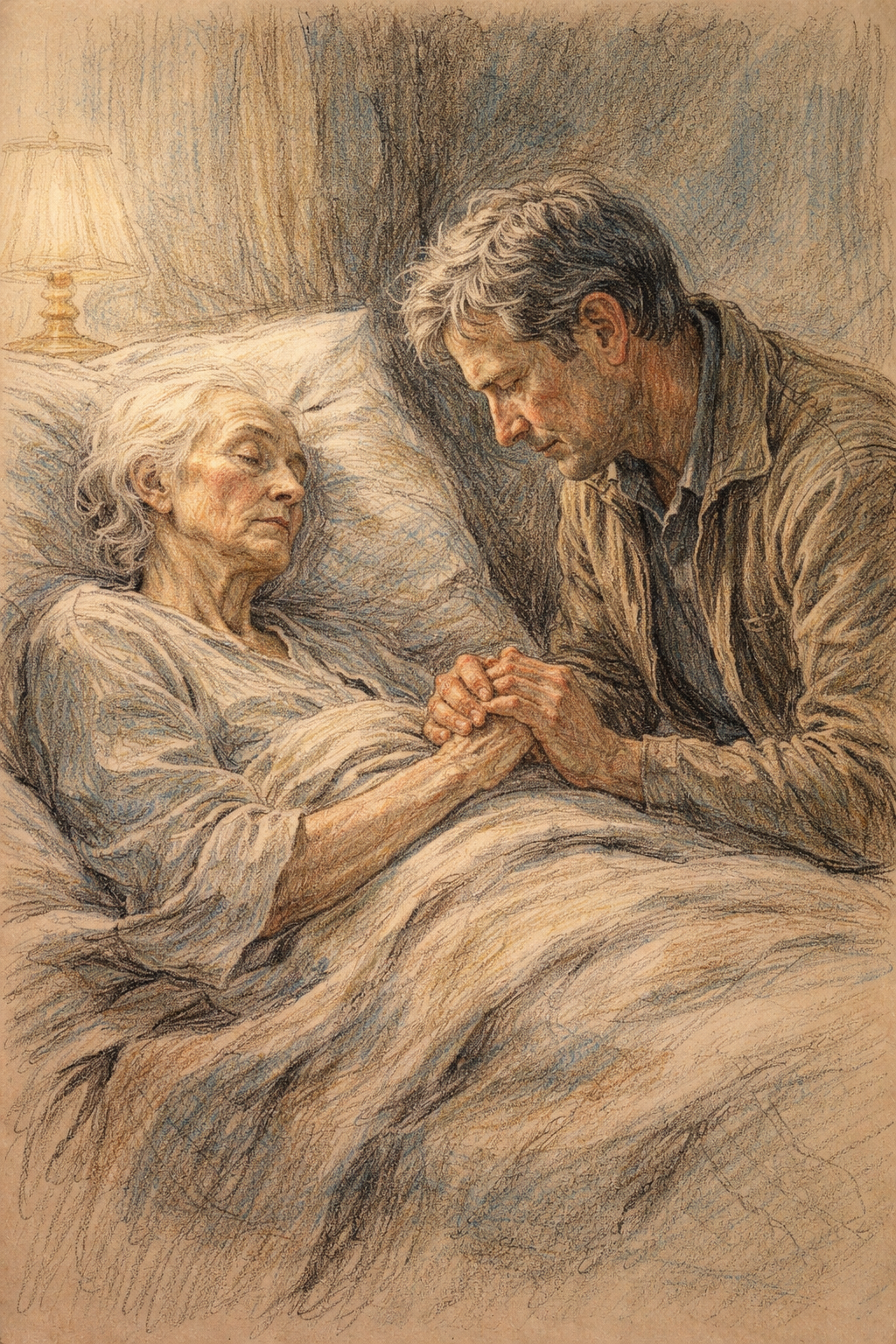
As they face death, our parents’ lives become illuminated before us, and many of us must face the realisation that we were denied the chance to truly know who they really were. Ai assisted image.
Here I present two examples:
Aristotle writes about tragic recognition in his Poetics. He defines it as:
“…a change from ignorance to knowledge, producing love or hate between the persons destined by the poet for good or bad fortune.” (S. H. Butcher translation, 1895).
For adult children watching their aged parents prepare for death, we can tie that tragic recognition to seeing that our mother or father carried a whole, intricate life before we ever entered it, and that we have loved them without really knowing who they were. It can be likened to the curtain falling just as the truth comes into view.
Augustine remarks in his Confessions, (Book I. 6-7), that even our own infancy is lost to us; we possess it only through other people’s stories and the faintest, unreliable traces of memory. If this is true of our own beginnings, it is even more true of those who came before us. Our parents’ youth, their early loves and failures, the selves they inhabited before we arrived, all of this remains a kind of prehistory.
As I sit with my own mother, watching as she stares out into the distance, I realise I am the poorer for not having known her as she grew and took her place in this world, with her eyes all aglow at what was ahead.
Now her eyes stare out into a place I am also unable to access. When I ask what she is thinking, she replies she doesn’t really know. Except for a few repetitive words and names of one or two people, I can’t see into that space she is lost in, nor what her memories are showing her. I can only guess.
Guessing is like putting together a puzzle – we gather our memories and formative views, placing them where we think they fit most perfectly. But prior to that treasure trove we call uniquely ours, there was a life of at least twenty years unknown to us. And it’s one we will never ever get to recall, nor find a place for the missing pieces in the puzzle we so earnestly seek to complete.
We are each shaped by what we experience in our young lives. We take those experiences, good and bad, and most of us try our best to let the good ones elevate above the bad. Our parents can tell us what their hopes and dreams were, explain their trials and disappointments, or leave their memoirs for us to read in much the same way we read about historical figures, but it doesn’t come close to understanding who they really are beyond the confines of our limited perceptions.
We can question, imagine, reconstruct, but we cannot ever stand inside those years. The sadness of watching them die is not only that we are losing what we know, but that we are losing forever the chance to know what we never did.