Owning Words, Burying Culture: Seneca, Copyright, and the Case for AI‑Made Images

Original photograph by Jade Hoogland, recreated as a vintage sketch-style botanical print.
I recently reached a crossroads in my creative world. Copyright has entered my orbit with its chokehold on my ability to incorporate the intriguing work of other writers into my own.
First, let me state that I am an avid defender of protecting people’s claim to their own original work. I abhor plagiarism, being schooled in its critical importance during my university studies. But I am not against work being shared with appropriate credit to the original creator. I believe everyone should have access to work they may otherwise never encounter, and by default, this makes our societies richer for the acquisition of knowledge and art.
As it pertains to the ancient world, it is not a concern as those works are safely beyond any possible breach. I write frequently and freely on antiquity, drawing upon many and varied accounts, speeches, and letters to incorporate into my own original work. But I meet the hoisted barrier once I arrive in the eighteenth century.
I’ve long held an interest in classical literature from antiquity through to early modern times, and in the idea and wonder of time travel. I recently created a website as the place to house all of my work in one vault. It currently has four distinct categories designed to appeal to readers’ specific interests, but connected enough that, should curiosity pique about other areas, they can be explored easily. For those interested, you can access the link here.
As the site is created as a Time Travel Portal, incorporating the various areas of history, literature, political theory and commonplace sayings across the timeline, I like to be able to refer to works such as the following in my reflective essays or dispatches, but sadly, it is a risk in almost every case:
Brer Rabbit, Joel Chandler Harris
Enid Blyton’s children’s books
The Bobbsey Twins, Laura Lee Hope
Trixie Beldon, Kathryn Kenny
Donna Parker, Marcia Martin
Black Beauty, Anna Sewell
Peter Rabbit, Beatrix Potter
Winnie-the-Pooh, A.A. Milne
Poetry of Emily Dickinson
The Country Diary of an Edwardian Lady, Edith Holden
Public domain status allows for free use of certain works, but it is limited, especially once one moves into the modern era.
Viewing books as property that required protection began to take legal hold in 1710 with the British Statute of Anne. By the late nineteenth century, with international agreements such as the Berne Convention, the law had largely shifted from protecting printers for a few years to protecting estates and corporations for generations, and by the late twentieth century almost everything you can see online is locked by default – often for the life of the author plus seventy years.
What benefit is it to anyone to covet such wondrous works of poetry and intriguing literature from the wider world? It certainly doesn’t benefit aspirational readers who may yet to develop an interest outside their own familiar genre. We cannot each know everything about all the works that have ever been produced.
Why the censorship on creators who wish to share with the world those works that are absent from the lives of others? As long as they give due credit, it is my view that writers should not be so restricted in bringing great early modern and modern work to those who have yet to discover its wonder. Is it not a great legacy for those who grant to posterity such creative work, in the same way the magnificence of the ancient world has been able to do?
Interestingly, tension over ownership of words appears in first century AD writings of Seneca, the Roman statesman, philosopher and dramatist. In a letter to his friend, Lucilius, on the subject of the philosopher’s seclusion, he interrupts his flow by writing that he must pay his “customary contribution” for the sake of balance, proceeding to quote from Epicurus. The full comment is worthy of quoting:
‘It is likely that you will ask me why I quote so many of Epicurus’s noble words instead of words taken from our own school. But is there any reason why you should regard them as sayings of Epicurus and not common property? How many poets give forth ideas that have been uttered, or may be uttered, by philosophers! I need not touch upon the tragedians and our writers of national drama; for these last are also somewhat serious, and stand half-way between comedy and tragedy. What a quantity of sagacious verses lie buried in the mime! How many of Publilius’s lines are worthy of being spoken by buskinclad actors, as well as by wearers of the slipper!’
Those antique writers were on to something!
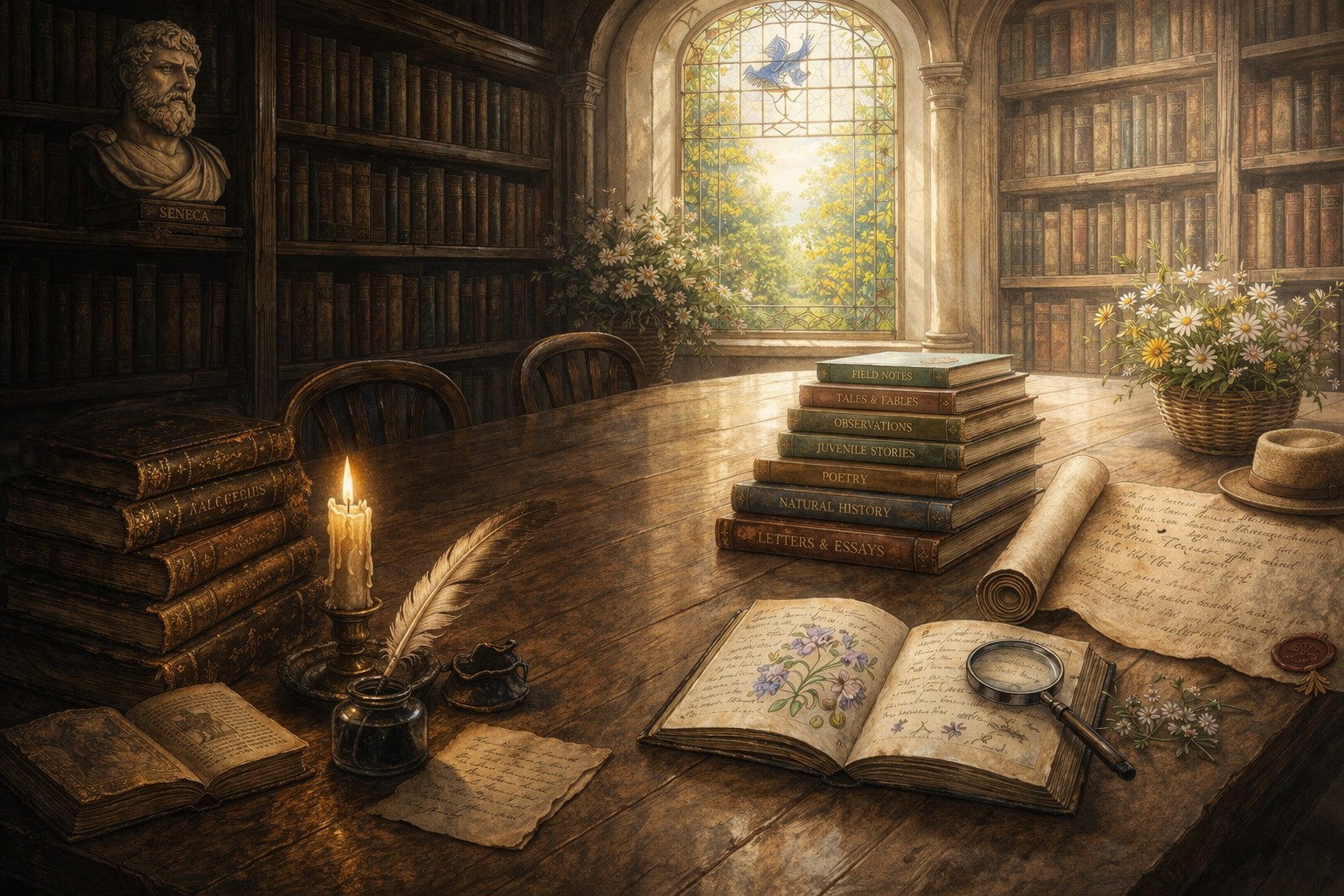
The merging of openly shared antique words and acquisition of knowledge, to early modern works. AI generated image.
Turning to imagery now, it is acknowledged that most people like to see an accompanying image in articles relating to literature.
Once again, I respect and support the need to protect an artist’s creation. But if writers are prevented from sharing images that accompany the written work with due credit, something of value is lost in the sharing of the message. Children learn the most from these, but even adults can glean more from an image than the words alone. We are, after all, different interpreters of information.
Perhaps some people have the ability to draw for themselves, but not all do. We can search high and low through our own photographs, sketches or paintings to match our words, and while I’ve had some success with that, it doesn’t work all of the time. Hiring an illustrator costs money, which is not viable for most of us.
So, what to do?
Enter AI.
This was my crossroads moment. I vowed I would never use this medium, but to my surprise I have embraced it. Finally there is a path to create my own images for my own writings, and a practical way to escape the mausoleum of locked up twentieth century imagery.
As a matter of reference for readers who visit my site, currently about two-thirds of the images I use are original photographs (my own or my daughter’s), and AI generated images, which also include recreations in the style of our original photos. The remainder is made up of publicly available stock images or those freely available from the public domain.
Originality must be protected. But it need not mean a padlock on it that prevents any sharing, with the appropriate credit to original creators. Our world is already too limiting on our speech. Let us not throw works of artistic interest into the dungeon with it!