In the Ruins of Troy: Hecuba and Fortune
Each generation tends to believe that theirs is paramount and all that preceded them is just noise from a distant past unrelated to their contemporary concerns.
History, of course, tells a different story. Euripides’ play, The Trojan Women, presents the fate of the women of Troy in the aftermath of Greek destruction. But it is the trauma that befalls Hecuba which most clearly shows how tragedy forces us to react and adjust to circumstances we did not choose.
Troy has been destroyed. Vengeance belongs to the Greeks. The god, Poseidon, abandons his once treasured city, disappointed by the Phrygians’ slackness toward the gods:
He laments that when desolation takes a city, piety withers, and mortals cease honouring the gods.
King Priam is dead, along with the children he and Hecuba bore, who are either slain or taken as prisoners. Her city no longer stands. Destruction is everywhere. Her lament is excruciating as she pleads with the gods to let her remain on the ground rather than be raised up to further misery:
She begs not to be lifted, asking why they guide the feet that once walked as a queen to a slave’s pallet of straw and stone, where she longs simply to lie and die of tears.
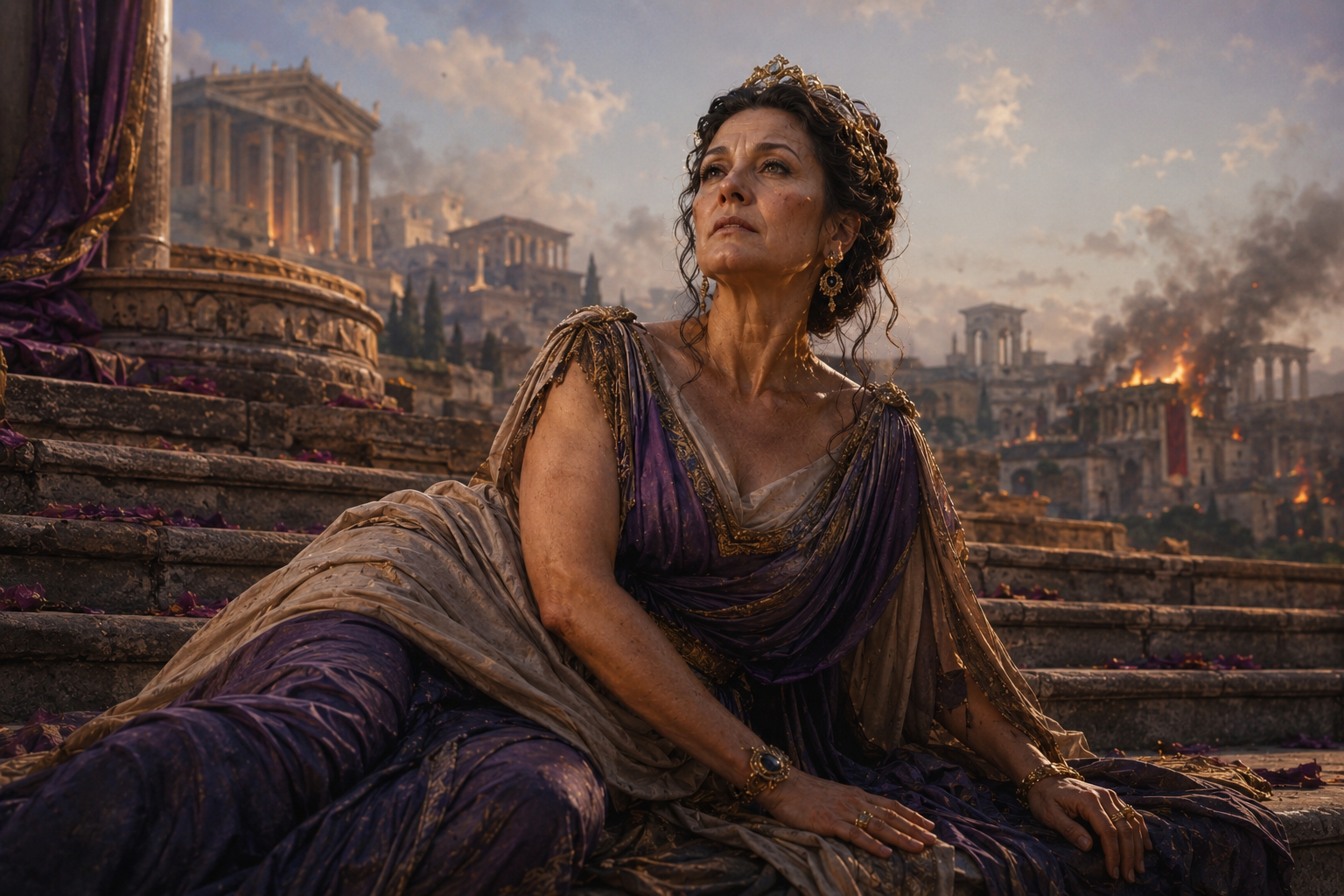
Hecuba lays on the steps of the burning city of Troy behind her, traumatised by her loss, but determined in her will to rise. Author’ own AI-assisted image.
When we cling to things decaying or denied us, it is only ourselves we destroy. What once was built can be built again – another of history’s quiet messages as we look back on past civilisations, ancient, medieval, and early modern.
The Greek tragedians confronted life and death in all their harshness through the medium of drama. Art remains a potent way to relay messages and warnings by which we may contemplate our own lives.
There are moments when the only wise thing to do is rise and walk away from the ruins and follow Fortune’s lead. Hecuba could not save Troy. She could only accept that the world had changed, and she must confront what remains. She is not content with Fortune’s verdict, but she refuses to allow herself to become its exhibit.
Through her agony and grief, Hecuba lifts her head up amidst the burning flames and fury of the gods:
She urges herself to rise, to see that Troy and its queen are gone, and to sail as Fortune directs, upon the sea of chance rather than drive the ship of life against the swell.
Perhaps one of the most potent insights Euripides has Hecuba say comes just before she collapses: she warns that no living person should be counted truly fortunate until their life is complete and their story closed.
It is a message that echoes through the ages, although I’m not sure many of us take heed of it. For here we stand today with the same misgivings the ancients lamented, still tempted to call a life “successful” long before we see how it ends.
Yet as we confront our own adversities, especially amidst the present global turmoil, we must remember that nothing is truly over until we reach the end. Our fortune may change in an instant, for good or ill. Only with that final perspective can we look back and say whether our lives were well lived, or not.